Categories
Construction Rapidways

from messy to marvelous – davis drive year in review

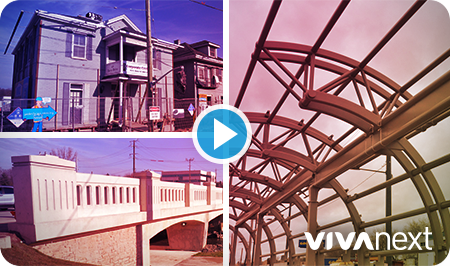
Video: from messy to marvelous - davis drive year in review

It’s an exciting time as the transformation of Davis Drive has made significant progress and is starting to be seen along the corridor.

A lot of progress above ground was made this year and a number of milestones were achieved, all of which clears the way for 2015 and the last year of construction. We thank you for bearing with us through the mess and as we work hard to finish as quickly as possible.

Standing at Yonge and Davis, you can look down Davis Drive and see the installation of boulevards and planters. As you travel to your destination you’ll notice the decorative planters along with interlocking paving stones and concrete sidewalks in areas from Yonge Street to Longford/Parkside Drive.

Construction of the vivastation at Parkside/Longford and Davis is making great progress. The steel structure for the vivastation is in place and the glass for the canopies will be arriving soon.

Construction of two more vivastations at Main and Southlake Hospital are also underway.

The structure of the Keith Bridge has been rebuilt and the Tom Taylor Trail has been restored to its original location under Keith Bridge; which is located just past the GO train station.

VivaNext will be moving to the next phase of rapidway construction where station platforms, canopies and eventually rapid transit bus lanes will be built in the centre of the road. As a result, there will be permanent changes to how motorists use intersections, traffic lanes and access businesses along Davis. New traffic signals have been installed at Yonge, George and Barbara. Drivers can now make dedicated left-turns and U-turns where U-turn permitted signs are posted. From our experience on Highway 7, these new movements help the traffic flow smoother. For more information on these important changes please visit vivanext.com

We captured a number of these accomplishments on video and condensed them into a short clip for your viewing pleasure. The investment in modernizing our roads and revitalizing Newmarket’s infrastructure will go a long way to making sure Davis Drive is built on a solid foundation that will serve the growing needs of Newmarket for many decades to come. We look forward to the rapidway opening in 2015 and bringing Viva service to Davis Drive.
Categories
Construction Rapidways

seeing the transformation unfold on highway 7 west

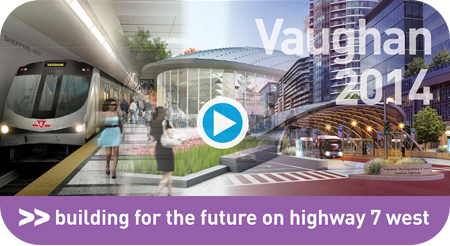
click here to see the video of 2014 Vaughan rapidway construction

we’ve been busy this year

Construction is well underway for the first phase of vivaNext rapidways in the City of Vaughan, and the transformation can be seen along Highway 7 West. Check out our latest video for an up-close look at the milestones we’ve accomplished this year. Although construction will continue throughout the winter months from Edgeley Boulevard to Bowes Road, here’s an update on the progress made in 2014:

  • Traffic has been shifted east of Jane Street to its final configuration, so that work in the centre of the road [including platforms and canopies] can begin in 2015.
  • As part of the 8-metre expansion of the Canadian National Railway [CN] MacMillan Bridge, we poured over 800 tonnes of concrete to create new columns and bridge pier caps.
  • Underground infrastructure revitalization continues – utility, telecommunications and storm sewer relocation is approximately 80% completed.
  • Road widening is completed and base-layer paving is 90% finished between Jane Street and the CN Bridge. Paving activities will continue in 2015.
  • In order to preserve the existing Black Creek and Hillside Culverts, retaining walls were built. In total, five retaining walls have been completed along the corridor with a few more set to get started in 2015.
  • Important traffic and pedestrian changes can be seen at several intersections. Motorists are benefiting from new turning movements and pedestrians now have two-stage crossings.

We know construction can be messy and disruptive at times, and we thank you for your patience and understanding as we continue the transformation. For up-to-date information on construction progress and activities, visit http://www.vivanext.com/hwy7progress.


Categories
Urban Planning

building great cities

Building Great Cities

York Region’s Centres and Corridors strategy is how our Region is making sure there will be room for our growing population to live, work and play, while also protecting our sensitive lands and green zones. As our Region grows, new homes, workplaces, retail and recreational facilities are being established all along the corridors, and clustered in higher density centres in Vaughan, Richmond Hill, Markham and Newmarket.  And to make it easier for people to get where they want to go, without always needing to get in their car, rapid transit corridors featuring Viva’s comfortable Bus Rapid Transit service will link those centres.

Centres and Corridors has been a key component of Regional Council’s strategic priorities, and the amount of development actively underway in all the centres shows that great progress is already being made. But what are the steps required behind the scenes, to create the kinds of communities that are taking shape in the centres?

The first step, and one that was approved long ago, is that Regional Council provided strategic direction confirming the Centres and Corridors plan as the foundation for the Region’s Official Plan.  The Provincial Growth Plan for the Greater Golden Horseshoe reinforces the principles of increased intensification and city-building, and specifically identifies the four centres as “urban growth centres.”

Included in the Provincial Growth Plan are targets for the number of people and jobs to be supported per hectare. The Region’s Official Plan includes these targets, and also establishes policies to encourage transit, pedestrian-friendly street designs, and mixed-use development.

Building on the Region’s policies, each municipality then has to review their own official plan to make sure it conforms and supports the Region’s plan. Municipalities then develop secondary plans, which set out specific land use rules and targets for defined areas including the centres.  Secondary plans shape future development, providing guidance on minimum densities, building heights, streetscaping and other strategies to encourage welcoming, pedestrian-friendly development.

Once the general rules for land use have been developed, municipalities and the Region then actively work to attract new employers and development investments.  Economic Development experts work with their Planning Department colleagues and with potential investors, to create new or expanded work opportunities.  A key driver for many of the new employment opportunities that have already been announced in York Region is the proximity to rapid transit, and the availability of a strong, educated workforce.

And the last component of our multi-pronged approach is to ensure that new housing options are available all along the corridors and in the centres.  We know that people want to live relatively near to where they work, with a short commute being highly valued.  The new housing developments that are springing up near our vivaNext routes are already providing very attractive options for people wanting an urban home, with great access to transit and work.

City-building isn’t a short-term process, but with all these components working together, bit by bit our centres and corridors are being transformed into exciting, urban places, while protecting and respecting existing developments and our natural environment.  For everyone, that means more options, more choices, and linking it all together, more Viva.


Categories
Construction

newmarket’s union hotel has a new home

newmarket’s union hotel has a new home

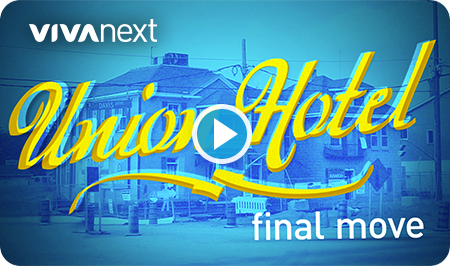
Rapidways are on the way to Davis Drive and to make room, the Union Hotel on the northeast corner of Davis Drive and Main Street has been moved to its new location at the back of the original property. It took careful precision and planning to move this old building to its permanent foundation and now it’s finally settled in. We captured the preservation of this important piece of history on video. Check out the full behind-the-scenes video to see how it was done.

Built in 1881, the Union Hotel is one of Newmarket’s many distinctive heritage buildings. Designed by local architect John Ough, it still has many of its original features, including mouldings, staircases and woodwork. Although it’s known as the “Union Hotel,” past owners include James Burke, who manufactured soda water here, Patrick Hodgins Sr., who used it as a store and residence, and more recently Robert Armstrong with a real estate business.

Relocating the Union Hotel ensures the gateway to Newmarket’s downtown heritage area is preserved.


Categories
General

design it, then build it – simple, right?

design it, then build it - simple, right?

You probably know where we’re going with this. It’s not simple to design and build a major transportation project, but we’re getting better and better at it.

It starts with a consistent vision of a transit system that matches plans for the future by the Province and the Region. A plan for making the vision a reality comes next, as dedicated lanes for Bus Rapid Transit – rapidways – connecting York Region’s key urban centres. It’s more than transit though, with designs including updated infrastructure and pedestrian-friendly, attractive surroundings. The 34 kilometres of rapidway and 37 vivastations are divided into design-build projects, based on funding and logistics. Closing roads entirely isn’t an option, so construction timelines are longer to allow for keeping lanes open as much as possible, and projects are staggered so that there isn’t too much work being done, all at once.

We select a contractor through a competitive bidding process. This is an important point in the project, because what is or isn’t included in the contract can impact the timing or costs of a project at a later point. We have highly-skilled engineering, construction and procurement professionals whose advice ensures we procure the project accurately and fairly. Even so, there are an enormous amount of details to consider, and every aspect needs careful thought. The procurement of each project has been tailored to its particular circumstances, and has improved on the project before it.

For the first rapidway project, Highway 7 East, the utility work and the design-build of the project were each coordinated by a separate contractor at the same time. The intention was for a quick build, but it was a challenge for two separate contractors to schedule intertwined work in the same locations.

For the next two projects, Davis Drive and Highway 7 West [Interchange Way to Bowes Road], the same contractor coordinated the utility work and built the project. This helped the contractor to schedule the work, although there were still unexpected elements underground to deal with, as is the case with most construction projects. The contract for the latter project, Highway 7 West, also included more requirements for utility coordination and recognition of timelines needed for permits and relocating utilities.

We recently procured the contractor for the rapidway on Yonge Street, and even more was done to ensure the project runs smoothly. A Subsurface Utility Engineering [SUE] study was fully completed before we even issued the RFP, and the results of the study gave bidders a better understanding of the existing infrastructure, preparing them for the utility work included in the contract. As with the Highway 7 West contract, timelines allowed for permits and utility relocation, and in this case they were fully scheduled. A requirement was also added for an Independent Quality Certifier [IQC] to make it easier to monitor and audit quality of work – previously this was a combined effort.

So building it isn’t simple, but each project has helped improve the next, and we’ve already built and put into service 11 vivastations and 6 kilometres of rapidway. Each project has unique features and challenges, but the end results are worth it… we hope you have tried the improved service on Highway 7 East, as Viva now travels in its own dedicated lane!


Categories
Construction

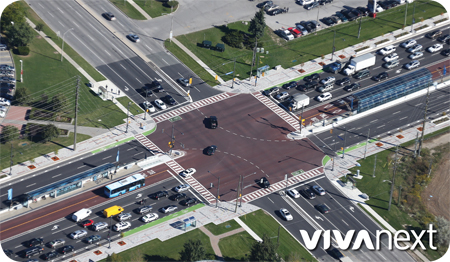
intersections are changing: u-turns and 2-stage crosswalks

intersections are changing: u-turns and 2-stage crosswalks

On Highway 7 West and Davis Drive in Newmarket, important changes are on the way for how drivers and pedestrians use intersections and travel along the road. Each rapidway project is at a different stage, and along the Highway 7 East rapidway in Markham and Richmond Hill, these road and intersection changes have been in effect for about two years.

Aside from rapidways for fast, convenient transit, projects include wider sidewalks and attractive landscaping. Each project helps to connect York Region, and manage future growth for generations to come. Once construction is underway in the centre of the road on Highway 7 West and Davis Drive, here are some of the changes that you need to watch for, and follow the signs:

Dedicated left-turns

  • Dedicated left-turn lanes at rapidway intersections
  • Dedicated left-turn signals – motorists can only turn left when the left-turn arrow is illuminated

Right-turn access, via intersections with u-turn signs

  • To access to mid-block destinations on the opposite side of the road, motorists will make u-turns at intersections.
  • Rapidway intersections with u-turn signs will allow drivers to make a u-turn from the left turn lane, once the left-turn arrow is illuminated.
  • Global studies of traffic control have shown this to be a safer way to turn left on a multi-lane road.

Shared lanes for right-turn and through traffic

  • Curb-side lanes will be shared by right-turning and straight-through traffic.

Two-stage pedestrian crossings

  • Intersections will be wider with the new rapidway lanes.
  • Pedestrians may cross intersections in two stages if unable to cross in the first signal.
  • A waiting area will be in the middle of the crosswalk, where pedestrians can press the “walk” button and wait for the next signal.
  • Pedestrians will need to press the “walk” button for the “walk” signal to be displayed.


Categories
General Going Green

planning for a rainy day

planning for a rainy day

If you’ve ever stood at the bottom of a hill in a field or forest at the end of a sudden summer rain shower, you’ll have seen how water naturally runs down to the lowest point, then gradually drains away, soaking into the ground and running into the nearest stream or pond. Obviously, water will always drain in a downward direction, even when a site becomes developed by roads or buildings. Engineers use what are known as “storm water management” techniques to minimize the negative impacts of changes in drainage associated with new development and construction.

The drainage needs of the widened road network that are being built for vivaNext are no different from those in a new housing development or a natural forest: at the bottom of every hill, water will collect and need to be drained away somewhere. So, storm water management has one overarching goal: to mimic as much as possible the natural, pre-developed conditions of a site in terms of both how water drains, and the quality of the water that is being drained.

There are a number of tools that are used in storm water management, depending on the situation. On the vivaNext rapidway project, the primary tool is the storm sewer system. Storm sewers run under the roadway, collecting water that runs off the road through storm sewer inlets. These inlets are either set horizontally into the road beside the curb, or vertically into the curb itself.

The more an area is developed or paved the less permeable ground there is to absorb run-off, resulting in more water needing to be drained through the storm water system. Specialists do hydraulic calculations to determine how much water will collect on the roadways during a typical storm, and ensure that the storm sewer system can drain it away promptly. Storm sewers drain into the naturally occurring creeks and streams that exist throughout our urban areas, although many have been buried so you won’t be aware of them. In some areas, these pipes may be aging and ready to be replaced to accommodate the increased volumes of run-off.

In addition to preventing flooding, the other critical component of storm water management is to mimic the natural conditions where rainwater is filtered through the ground, leaving the eventual run-off as clean as possible.

To replicate this natural filtering mechanism on roadways, water collected in the storm sewers runs through a special filter called an Oil Grit Separator [OGS] before it is released into a creek or stream. OGS are designed to capture substances like grit, oil and sand that collect on a roadway and get washed away during a rainstorm.

Another tool to improve the quality of run-off is the use of storm water management ponds, which contain and filter the outflow from storm sewers in a more natural way, trapping the grit and oil in their muddy bottoms, producing cleaner water that flows into watercourses or pipes.

Storm water management is an important issue that is overseen by a variety of approving bodies, including federal and provincial ministries, and in the case of our vivaNext projects, two conservation authorities.

How we plan drainage for water is one of those important components of any project that will be unseen to most. But whether or not you can see it, respecting the natural environment is important to everyone, and in the last few years the storms and crazy weather we have experienced have truly made that more apparent!


Categories
Rapidways

next is now >> highway 7 in markham

next is now >> highway 7 in markham

We’re growing right along with you as we enjoy the next section of the rapidway, now open along Highway 7 from Highway 404 to Town Centre Boulevard.

Riders can now board Viva in the centre-lane rapidway, and vivastations are directly accessible from crosswalks at traffic lights. Not only is this section of Highway 7 now more efficient for pedestrians, cyclists, riders and drivers, but the landscape is being transformed with new trees and other greenery. Vivastations are in service at Allstate Parkway, Woodbine Avenue, Montgomery Court, and Town Centre Boulevard. New dedicated centre lanes for Viva allow riders to enjoy faster and more consistent travel times through this congested area. Our customers are telling us “@YRTViva Love how fast the bus is on the new extended rapidway. Got to the mall really quick!”

Markham is one of the fastest growing municipalities in Ontario, home to over 332,000 people, covering 212 square kilometres of land. More than 400 companies are headquartered in Markham due to a well-defined transportation and communication network, high quality facilities, a diverse and highly educated labour force and pro-business environment. The vivaNext transformation of this urban corridor will help support growth, and reduce congestion to help make Markham, and the rest of York Region, a more inviting place to live, commute, shop and play.

For Highway 7 East, the future of rapid transit is here – next is now. Students are settled into school already, so here’s a [fun] lesson on history – watch our then, now & next transformation video of Markham and be sure to get out and experience the new rapidways this fall!


Categories
Community Events

taking time for thanks

taking time for thanks

It’s a beautiful time of year and of course, a time to be thankful. We thank everyone for their patience during the messy stages of construction. Great things are on the way – vibrant urban places, new infrastructure and rapid transit choices will support future generations of our growing population.

This weekend we’ll be gathering with the community in Vaughan at the 2014 Woodbridge Fall Fair, so be sure to drop by our booth in the vendors’ tent to chat and find out more about vivaNext projects:

Woodbridge Fall Fair

When:

Saturday, October 11, 10am to 6pm
Sunday, October 12, 10am to 6pm
Monday, October 13, 10am to 5pm

Where: Woodbridge Fairgrounds, 100 Porter Ave., Vaughan (Kipling, north of Hwy 7)

Description: live music, giant vegetables, horse shows, midway rides, a dog performance team, petting zoo and children’s entertainers. www.woodbridgefair.com


Categories
Construction

working together on transportation improvements in newmarket

working together on transportation improvements in newmarket

To help alleviate traffic congestion and provide convenient transit alternatives in Newmarket, vivaNext, York Region and the Town of Newmarket are investing in infrastructure and improving public transit in Newmarket.

While it may appear construction is taking place everywhere in Newmarket, a comprehensive coordination strategy was developed by York Region, vivaNext and the Town of Newmarket to better balance the need for necessary infrastructure improvements with the needs of our residents, visitors and commuters and to help manage travel demand in Newmarket, while minimizing the disruption to the community.

To support future growth and travel demand and to help reduce traffic congestion in Newmarket, road improvements are necessary and long overdue. A number of construction projects performed by York Region, Town of Newmarket and vivaNext are underway that will reshape and re-vitalize Newmarket. These road construction projects are a sound investment in Newmarket’s future.

To maximize as much work as possible during a short construction season, the majority of construction projects are done in the warmer months. Construction can be frustrating and we thank you for your patience as we work together to improve our roads and transit system so that Newmarket continues to be one the best place to live in Canada.

Information on the construction projects taking place within Newmarket are available at www.york.ca, www.vivanext.com, www.town.newmarket.on.ca.