Categories
Construction Rapidways Stations

getting to where you want to go

The continuation of dedicated rapidway along Highway 7 East – from Bayview to Town Centre Boulevard – has resulted in some important changes to the way drivers get to their destinations, and how the traffic signals work.  Some of these changes have already become familiar to drivers on the west leg of the rapidway and during the construction phase of the east end, but it’s worth going over them again –

    1.Watch for your signal. 

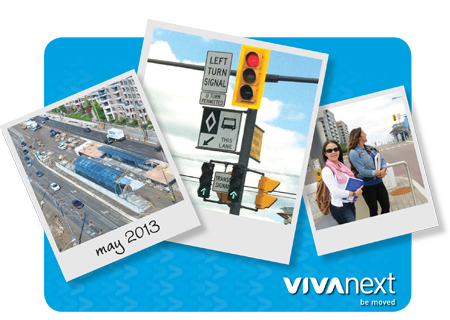
    There are several different signal phases now operating along Highway 7, and drivers need to be extra alert to pay attention.  The left turn arrow, transit arrow and through traffic signals all work together to keep traffic moving safely.  Pay careful attention to the signal for your lane and the movement you want to make. Watch for pedestrians in the middle if you are making left hand turns or U-turns.

    2. Left turns only during the left turn arrow.

    With the rapidway down the middle of the roadway, drivers cannot make left turns mid-block.  Left turns are only allowed from the left turn lane at intersections, on a dedicated left-turn green arrow.  White lines clearly show the left lane turn.  No left turns are allowed on the through green light phase, or the transit green arrow.  Special detectors in the pavement will help the light know how many cars are waiting to turn left, but depending on the length of the queue you may need to wait more than one cycle to make your turn.  If there are no cars detected at a specific time, there will not be a left-turn arrow in that cycle.

    3. U-turns are allowed during the left turn arrow.

    If you want to get to a destination on the other side of the road, you can make a u-turn at the intersection when the left turn arrow is lit.  It is important to make sure you turn into the main traffic lanes going in the other direction rather than into the rapidway.  To make it obvious, rapidways are tinted red and have special bus-only markings on them.  U-turns, like left-turns, cannot be made on a through green light, or when the transit arrow is green.

    4. Transit green arrows are for buses only.

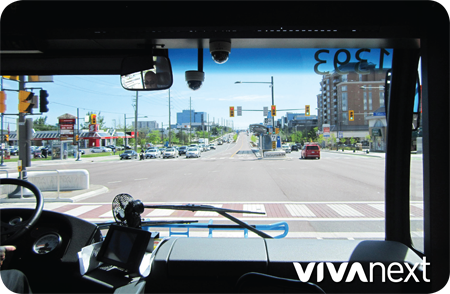
    The vehicles using the rapidway have their own signal, which is located directly in front of the rapidway.  This signal is only for buses, and depending on the circumstances, it may or may not coincide with the through green light for traffic.   The transit signal has a special hood over it so it can only be seen by transit drivers.  But whether or not a transit vehicle begins to move through an intersection, other drivers must wait for their own green light before proceeding.

    5. Be careful making right turns, watch for signs.

    There some changes to right turns on Highway 7 from side-streets.  At some intersections, right turns are no longer allowed; drivers need to watch carefully for signage on the traffic lights.  Drivers turning right need to be especially alert watching for bikes using the new bike lanes and bike boxes, and when making right turns past YRT buses stopped at curb-side stops.

Highway 7 is a busy street and safety for everyone using it is a top priority.  All these changes work together to get everyone where they want to go safely and in good time.   Stay tuned for the new section opening this August!

Categories
General Rapidways Stations

safety first!

Taking steps to ensure our passengers feel secure and safe using the new Viva stations is a top priority for YRT/Viva.  Every detail of our new passenger stations on the Highway 7 rapidway has been designed with a view to make riders feel comfortable, well protected from the elements and adjacent traffic, as well as able to access help in an emergency.

With our median platforms located in the middle of a busy roadway, one of our top priorities has been to make the stations feel like a safe haven.  Stations will provide a secure waiting place for passengers with a concrete barrier wall running all along the traffic side, and a glass guardrail beyond the canopy.

To access the new stations in the median, pedestrians must use the crosswalks and cross with the signal.  When crossing the road to or from the new station, you must remember to push your pedestrian button to get the signal indicating when you can cross safely.  Also, because this is new for everyone, it is important that pedestrians watch for traffic before stepping out to cross the road – there could be cars making left-hand and u-turns.  Whenever there are changes, it is important to be aware of all the users to the roadway to ensure your safety at all times.

The new Viva stations reflect the CPTED (Crime Prevention Through Environmental Design) principles of transparency and good lighting, enabling people to see and be seen. We’ve paid careful attention to lighting levels, including along the platform and in the glass enclosure, which is fully visible to the platform and has doors at either end.

Each platform is well equipped with electronic security devices, overseen 24/7 by YRT/Viva staff at transit headquarters.  Stations are monitored constantly by three CCTV (Closed Circuit Television) cameras.  In addition to providing good coverage of the platform at all times, transit staff can maneuver the cameras manually as needed.

To add to passenger’s sense of security, a clearly marked Emergency Call Button (ECB) is located inside the glass enclosure, and its speaker provides immediate two-way contact between the caller and YRT operators.  The audio of the call is recorded and time-stamped, as is the video that is automatically captured by the closest camera when the button is pushed. When the ECB is pushed, blue strobe lights on the VMS and on the ECB will be triggered to indicate to passing emergency services that assistance is needed, and transit staff will dispatch emergency services if required.

Also adding to these new features is the PA system that will be used to provide live and recorded public announcements from transit operations, which we talked about in a previous blog.

These new features are probably things that most people will never need to think about.  All the same, knowing that we’ve gone to great lengths to maximize our passengers’ sense of safety, and that our transit staff are on duty 24/7 behind the cameras, should give all our riders total peace of mind.  Be safe!

Categories
General Rapidways Stations

we can hear you, loud and clear

Most PA systems are pretty frustrating in the garbled sound quality they provide. But at vivaNext the engineers have worked hard to design the optimal public address system for your new vivastations.    There’s nothing worse than knowing something important is being said, but not being able to understand it or hear it properly.

To make sure the new PA system is always audible, we started with an acoustic analysis study using special “Enhanced Acoustic Simulator for Engineers” (EASE) software. This study analyzed the two elements most critical to sound: Sound Pressure Level (SPL) and Speech Transmission Index (STI). The SPL, measured in decibels (dB), is concerned with sound magnitude and takes into account ambient noise levels – it is the relative “loudness” of a sound.  STI predicts how the equipment being used and the surrounding environment will affect the quality of the sound, and therefore how intelligible it is for you as you hear it.

First, the acoustic engineers needed to determine what effects our curved canopies and the beams and angles inside the station would have on the way sound is going to move around.  Secondly, the reflection of sound by the concrete wall, floor and glass was modeled. This analysis helped predict how clear the final sound will be on the platform and in the enclosure, and also helped determine the number and placement of speakers that will be most effective in achieving clear sounds.

Following this sophisticated modeling the engineers determined that the optimal number of speakers to achieve these goals would be 12 speakers located outside of the passenger enclosure, and another 3 speakers inside.

The next challenge was to work on the volume of the speakers.  The problem with PA systems in noisy places is that the ambient noise can overwhelm the volume of the PA system, making it impossible to hear what’s being said.  Our solution is to use a speaker volume system that automatically adjusts when its sensors detect that the ambient noise has increased or decreased.

There are two sensors on each new Viva platform to measure noise level. This way, announcements should be audible whether there’s a bus idling in the station and trucks are moving past, or it’s nighttime and quiet. Volume control and environmental sensitivity helps determine the right sound levels without disturbing those who don’t need to hear the message.

The PA system will be used for recorded and live announcements from transit operations, such as emergency information or service changes.  It will not announce bus arrivals at this time, although it does have that capability should we want to turn on that function.

Although we’ve tested the system many times, we continue to monitor the sound levels, so let us know if you can truly hear us, loud and clear.


Categories
General Rapidways Stations

ITS – balancing the needs of all travellers

Gridlock is an increasing problem everywhere across the GTHA and most other large cities.  But what can be done about it?  VivaNext is one part of the solution.  With the new vivaNext system comes improved ITS – which isn’t what you think…

Some people may think ITS is connected to “Information Technology”, but in the vivaNext world ITS stands for “Intelligent Transportation Systems”. ITS is an international transportation-engineering discipline that is trying to improve the efficiency of travel, whether it involves the travelling public, commercial vehicles, or transit.  The basic assumptions behind ITS are that delays cost money, and more efficient travel saves money. This new technology is an absolutely critical component of the vivaNext program, although with low-visibility.

ITS is used to ensure that traffic corridors are designed as one coordinated system – the physical roadway’s design, lane markings and signs, traffic signal design and timing, and the brains that connect all these pieces.  In a transit project, ITS has an additional layer which is concerned with how the transit system is integrated into that larger system.

As high-tech as each of these components are, none can be effective unless it can communicate with the others.  Each one also needs to be connected to the overall transit system which keeps track of the schedule for each bus, and which determines when the traffic signal phasing requires a temporary adjustment to let a delayed bus get back on schedule by holding a light.

The connection is provided through a fibre optics communications network that links all of the intersection and every vivastation to YRT’s transit operations and York Region’s traffic operations.

This system is fully automated, with approaching vehicles alerting intersections that they are arriving, and each intersection sharing that information with the central traffic control system, which in turn compares that information with the transit schedule.  The system is continuously adjusted and fine-tuned to ensure the buses stay on schedule, while keeping the roads and intersections working well for everyone.

To enhance passenger safety, each station is equipped with cameras to monitor the platforms, a public address system to provide announcements and an emergency call box for personal safety.  All of these systems operate reliably and seamlessly over the new fibre optic communications system.

The future Highway 7 will be significantly more urbanized, with more people living and working along the corridor.  That means there will be more transit riders, pedestrians and cyclists whose travel requirements need to be considered, in addition to car and truck traffic.  Helping transit vehicles stay on schedule is also a priority, since rapid transit can’t be rapid if it’s stuck in traffic.

These ITS strategies help balance everyone’s needs, to get everyone there as fast as possible!  It truly is a balancing act!


Categories
Construction Rapidways

testing, testing, testing

testing, testing, testing

As you will know from driving along Highway 7 East from Highway 404 to Warden, our rapidway construction is really coming along, and this summer another segment will be going into operation. We still have a bit more work ahead of us before service operation can begin, including some work which will be obvious, such as final paving, striping and landscaping. But in addition to that, we’re just getting underway on a less-obvious but highly important part of the job, which is testing – to ensure that all parts of the rapidway project are ready for active service.

This stage – known in the construction world as commissioning – is critically important and planning for commissioning the new section of Highway 7 East rapidway has already been in progress.

So what does commissioning involve, and how do we do it?

First of all, the technical definition of commissioning is: the process of assuring that all systems and components of a system are designed, installed and tested according to the operational requirements that have been established.

In the case of vivaNext, the most visible components of the project include the new roadways, passenger stations and amenities, and streetscape elements such as lighting, sidewalks and landscaping. Ongoing inspections are being done as construction progresses to ensure that these are being built to certain specifications, before they are handed over for use by Viva. Commissioning is a detailed focus on the key systems and components that together make up the overall network.

These components include the fare collection equipment; the station information systems such as the variable message signs, clocks and Public Address systems; passenger security elements such as closed circuit TV systems and emergency call buttons; and the traffic signals at intersections. It also includes the sophisticated Transit Vehicle Detection system, which will provide information to the traffic signals when rapid transit vehicles are approaching intersections, as well as the overall communications system and fibre optic network that links all of these components.

Testing starts at the factory, where the fabricator verifies that the equipment works as it was intended to, and then each component is tested again once it’s installed. Once all the components are installed and each one is confirmed to be working as designed, a series of additional tests are carried out to confirm that the entire system is integrated properly and working together. Don’t forget we have to connect up to the section already open and make sure everything continues to run smoothly.

The final step involves testing the reliability and function of the extended system, including simulating actual operation using buses and staff acting as passengers. This gives the people who will be involved in the future operation, maintenance and service of the rapidway an opportunity to become familiar with the new section.

So you can see that there’s still a lot of work behind the scenes to get to the day we’re all looking forward to – when the Viva bus extends its journey the length of the new rapidway from Bayview Avenue to South Town Centre Boulevard in late August.

Categories
Construction Rapidways

turning on the lights

turning on the lights

Street lights are one of those infrastructure elements that the public may not give a lot of thought to, but in truth their design contributes significantly to the overall streetscape. And because the vivaNext project is being used to transform Highway 7 East from a highway to an urban corridor, all the design components, including the street lights, have been given a lot of thought. But before design considerations can be focused on, safety is the first priority to be achieved with street lighting. VivaNext works with York Region, the local Municipality and the utility companies to develop lighting designs, coordinate and install the lights. Here’s an overview of the role lighting plays in the vivaNext vision, and the street lighting elements you will see installed on all the rapidway corridors.

Designing street lighting, like all the major elements in the vivaNext project, focuses on achieving a combination of practical and design objectives. Lighting is first and foremost a public safety consideration. There are strict national and local standards on how street lighting is designed, including how much lighting is required for different conditions. For example, different measures are used to determine the lighting levels for roadways compared to intersections and sidewalks. Once the levels are known, lighting designers develop a design, which includes variables such as pole height, spacing and “lux,” which is the amount of light to be provided by the fixture.

Once the lighting design is done, streetscape design objectives can come into play in order to marry the technical requirements with the architectural priorities needed to achieve the desired streetscape “look.” In the case of vivaNext, the streetscape objectives are for a modern, stylish and uncluttered look that will contribute to the corridors feeling like urban destinations, and make them distinctive from other Regional roadways.

To achieve all these safety requirements and design objectives, we have selected a special street light pole and luminaire [the light head or fixture], and arm that holds the luminaire, to be used along the Highway 7 rapidway segments. The poles will be a little higher than the ones they’ve replaced [9.9 metres high versus 8.0 metres], and they’re made of metal with a dark grey powder-coat finish for long-wear and less maintenance. Unlike most poles which are octagonal shaped and tapered to the top, these are round and cylindrical for a sleeker, more modern look. And the lighting head or luminaire on top was chosen to complement the sleek, modern look of our canopies.

The street lights also have a photo sensor to automatically turn on and off when it’s dark. And the bulbs – which are little larger than the light bulbs you have in your home – only need to be replaced every 4 years.

So next time you’re sitting at a stop light or at a bus stop and you’re looking at the beautiful new streetscape, you’ll know more about all the decisions that were needed to turn on the lights! Enjoy!!

Categories
Construction Rapidways

bringing the vivaNext long-term plan for the future to life

video - Highway 7 East: summer update 2014

With crews working on the finishing touches on the eastern half of the Highway 7 rapidway, we’re getting closer to the completion of this rapid transit corridor. As much as we’re looking forward to celebrating this milestone, it’s only one [very exciting] step in a long path that started years ago.

There’s a lot of media coverage these days, of transit needs all across the Greater Toronto and Hamilton Area [GTHA], and we’re proud that York Region is actively working to bring rapid transit to our region. In 2002, the Region produced the York Region Transportation Master Plan and the follow-up Rapid Transit Plan, committing the Region to a blueprint of multiple transportation initiatives to be built over the next 30 years.

With approval to the Rapid Transit Plan, we got to work and in 2005 the Viva team launched “QuickStart,” the first phase of Viva service. Viva offered enhanced features that made transit more comfortable and convenient, and put the customer first. With ridership levels increasing steadily, Viva changed the way people in York Region thought of transit and there was appreciation for the higher level of services with enhanced features and frequencies.

But while our new Viva service was a major success and an important first step in encouraging people to try transit, designing the vivaNext rapid transit system was the Region’s long-term vision. Ontario municipalities are mandated to plan sustainable, more intensive land-use as part of the provincial government policy, and rapid transit is a key component in achieving that goal. Anticipating this, the Transportation Master Plan directed that future growth in York Region would be concentrated in new downtowns in Markham, Newmarket, Richmond Hill and Vaughan. By building more intensively in these areas, there would be less pressure for growth in existing neighbourhoods.

These urban centres would be connected by transportation “corridors,” making it easier for people to get around the region and providing transportation options, such as regular transit service. The vivaNext rapidways are being built along the corridors, providing these connections across York Region and into the rest of the GTHA.

Much of the new development being built around vivastations is compact and mixed-use, providing housing, employment, retail, dining, services and recreation, all within walking distance of transit. Developments include more welcoming public spaces, attractive landscaping, and other amenities that contribute to the centres becoming more dynamic destinations.

The plan is well and truly underway, and rapidways are being built on Highway 7 in both the east and west, as well as in Newmarket. The Toronto-York Spadina Subway Extension is under construction, and the designs for rapidways on Yonge Street are being finalized. Great new developments are popping up all over the new urban centres across the Region.

So when the next segment of rapidway on Highway 7 East starts service this summer, we can all celebrate the implementation of the first phase of our transportation and growth management blueprint, not to mention the end of construction! Check out the new video highlighting the Highway 7 East segment.

Categories
Live-work-play Urban Planning

then, now & next: Newmarket’s moments in time

then, now & next: Newmarket’s moments in time

Take a moment to travel back in time with vivaNext as we explore the past, present and future of the rapidway corridors. Over the next month, we’ll be digging into photo archives to explore each community’s unique heritage and showing you how the vivaNext projects will be part of this history.

First up is the charming Town of Newmarket! It became an official town in 1880 with a population of 2,000. Today, the town has 84,000 residents and continues to grow. It boasts small town charm, but has all the conveniences of a big city. Several historical pieces of architecture still remain in Newmarket today, and as part of the Davis Drive rapidway project, we are preserving these important pieces of culture that contribute to the Town’s character.

The Union Hotel was built on the northeast corner of Davis Drive and Main Street. The two-storey brick structure was designed by local architect John Ough and still has many of its original features. Past owners include James Burke, a soda water manufacturer, and Patrick Hodgins Sr. whose family used it as a store and residence. To allow for the widening necessary to accommodate the vivaNext rapidway, the Union Hotel and neighbouring two-storey concrete block building are being set back on the same property, to preserve them as a gateway to historical Main Street.

The Keith Bridge is also being reconstructed as part of the vivaNext rapidway project. Newmarket’s rich architectural and transportation heritage was the inspiration for the design of the new Keith Bridge. When finished in 2014, the reconstructed Keith Bridge will feature several historic design elements including replica period light fixtures and poles, and decorative concrete railings. Heritage lighting will accent the bridge and architectural detailing will retain a historical flavour.

Once complete, the Davis Drive rapidway will help to support successful urban revitalization by encouraging the development of attractive and pedestrian-friendly places for people to live, work, shop and play. Watch Newmarket’s then, now & next story and stay tuned to our YouTube channel for more videos on Richmond Hill, Vaughan, and Markham!


Categories
Construction Rapidways

signs of progress

signs of progress

We’re really counting down the days to the next section of the vivaNext rapidway service opening on Highway 7 East from East Beaver Creek Road to South Town Centre Boulevard, and we know you are too! You’ll know we’re really in the final stretches of construction once you see Viva buses out on the new section of rapidway starting next week.

YRT\Viva will be doing driver training and testing on the Highway 7 East new section in the City of Markham, starting July 28 for a few weeks.

Training will be provided for everyone who will need to be familiar with the rapidways, the stations and equipment. There will be vehicles out on the rapidway, taking customer service staff and other YRT\Viva staff along the rapidways to test and familiarize themselves with the new section. Regular transit service will continue to pick-up passengers at the curbside stops, while we do the testing and finish paving the new section. Signs directing passengers will be posted at the stops.

The actual operator training will run from 7am to as late as 9pm some nights, seven days a week. During this time you can expect to see Viva buses running up and down the rapidway, and stopping at stations. The training will focus on entering and exiting the rapidway, and especially entering back into mixed traffic under Highway 404 and past South Town Centre Boulevard.

Training will also focus on the new transit signals at intersections, which will provide a single green arrow for transit operations. This signal will be clearly marked as being for transit only, but YRT\Viva operators will be trained to be cautious and on the lookout to make sure members of the driving public are obeying the signals correctly and not turning into the red rapidway lanes.

The trainees are all experienced Viva operators, so they know the route and the vehicle and have been enjoying the first phase of the rapidway that opened last year on Highway 7; this is just another segment of the system now running in its own dedicated lanes. They’re really excited to get going, knowing that there are just few more weeks of construction ahead of them.


Categories
Construction

the challenge of relocating utilities

The Challenge of Relocating Utilities

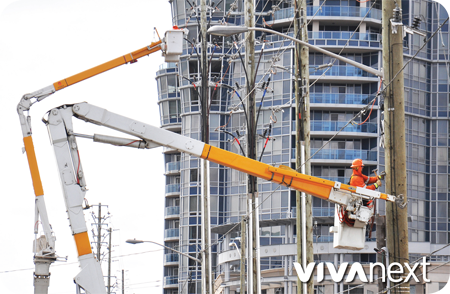
If we were building our vivaNext rapidways across undeveloped fields, widening the roadway to incorporate the median bus lanes would be a straightforward construction project involving excavation, building the road base and drainage system, boulevard and station construction, installing illumination, and paving. But, in all our projects, there are many existing utilities along the roadways that need to be moved first. Believe it or not, this part of the project – relocating existing utilities – can sometimes result in the greatest amount of complexity and schedule coordination. Here’s a primer on why this least-obvious part of the project can be so time-consuming, but is so critical, yet so complicated.

Utilities – which on our projects include a wide number of companies providing electricity, telecommunications, cable and gas – are typically private entities, which in some cases have connections to local municipalities, and in other cases are private for-profit organizations. In all cases, utilities own their own infrastructure and are responsible for designing, installing, paying for, and maintaining it. Utilities have direct relationships with their own customers, and have to plan for, manage and respond to service interruptions.

With so many users relying on the services along the roadway corridors, we need to work together before we can widen the roadway for the vivaNext project. A first step is to identify existing utilities, to confirm what has to be moved out of the way. To complete this first step, we collect all the information we can, including “as-builts,” which are drawings showing the location of existing utilities. Using the as-builts [and sometimes ground penetrating radar], we then carry out physical locates, where we dig small test pits to confirm that utilities are where we think they are, and what condition they’re in.

Once there is agreement on which utilities need to be moved, each company designs a new alignment for their service, or designs a shared structure such as an underground duct bank, with another company. These relocation designs have to work with our project’s requirements and dimensions [and our project’s design has to provide for a reasonable relocation design for the utilities], as well as with the alignments of all the other utilities. Just completing the design coordination and review alone is a complex and iterative process.

With the utility relocation designs complete, municipalities and other approval bodies such as the Ministries of Environment and Natural Resources and local conservation authorities – and railway companies where rail crossings are involved – review, comment on, and hopefully approve the plans. In many cases, private property owners also need to agree to provide access to the utility companies, adding yet another layer of complexity and coordination.

The final stage is the actual construction of the relocated utilities. Because there are strict construction rules about the separation required between crews, we work carefully to sequence the relocation work.

The roadway widening cannot be completed until utility relocations are finished in any given area. And as in any activity where multiple organizations have operations underway, we all need to work together collaboratively, and coordinating our efforts is critical, so we can get the rapidways built and in service for you. Like I said….complicated!