Categories
Announcements General

happy new years from vivaNext

The New Year brings with it the wonderment and joy of new possibilities, resolutions and change. Civilizations around the world have been celebrating the start of each New Year for at least four millennia. Traditions have varied (and still do today), ranging from forgiving enemies to exchanging gifts, to wishing Happy New Year and making resolutions. Many of us have made resolutions over the years – committing to renew last year’s resolutions, adding a few new ones, and to keep them as long as we can.

Naturally, vivaNext is committed to keeping its resolutions, which include:

  • Continuing our progress on rapidways in Newmarket, Richmond Hill, Markham and Vaughan, and on the Spadina Subway extension as quickly as possible;
  • Creating beautiful urban spaces where people can live, work and play in close proximity to rapid transit, check out Highway 7 between Bayview and the 404 Highway to see the results; and
  • Staying engaged and available to the residents and businesses in our communities.

Have a safe and happy New Year.  We look forward to a productive and successful 2014!

Categories
Community Events General Live-work-play

spending quality time with your loved ones

This holiday season we hope you have the opportunity to gather together, to share, reflect and renew the love and laughter that makes quality time with family and friends precious and meaningful.  York Region has a lot of great sites and events that you can explore on YRT\Viva transit lines over the holidays, from skating at the Markham Civic Centre outdoor rink, First Night Celebration in the Town of Richmond Hill, to the Winter Wonderland at the Riverwalk Commons in Newmarket.

Here at vivaNext, we are also taking this time to rest, relax and rejuvenate so come January we will be ready to jump into work.  The New Year will bring with it the continuation of construction on Davis Drive in Newmarket with road widening, utility relocation and paving.  The Highway 7 transformation in the City of Markham is continuing with utility relocation, boulevard streetscaping and paving. Work will also ramp up on the west side of Highway 7 into The City of Vaughan with retaining wall construction and utility relocations. And on Yonge Street in Richmond Hill and Newmarket, preparation for construction will start to take place.

Until then, please enjoy the season with those near and dear.  See you in the New Year.

Categories
Construction General Rapidways

as the cold wind blows…

Seems like just yesterday vivaNext was ramping up construction activities at the first sign of warmer temperatures and while the warmer weather was here this year, a lot of progress was made along the vivaNext corridors. We captured our developments and put together a short video to share the progress of the transformation for each corridor.

Building on our successes, we will keep the progress moving even as we wind down for the return of Old Man Winter. Although the weather specialists forecast a cold winter season, our vivaNext construction projects will continue as the snow flies and the cold wind blows.  Here’s a snapshot of what we’re going to be working on this winter along the vivaNext corridors and how we’ll manage to keep construction moving along even when the temperatures plunge.

In Newmarket, crews will continue storm sewer installation, utility relocations and underground ductbank [gathers together and encases telecommunication wires] installation along Davis Drive. The south side of western creek culvert near Niagara Street will be also be widened over the next several months.

In Markham, utility relocations will continue on South Town Centre Boulevard, Cedarland Drive and Warden Avenue. Some construction work will also continue on Highway 7 East in the centre median.

Along the Vaughan Metropolitan Centre [VMC] corridor, hydro, gas and telecommunications installations and relocations will continue. Work will also begin on the CN Bridge. Preliminary construction activity also continues in Vaughan along Highway 7 West from Helen Street to Edgeley Boulevard and from east of Bowes Road to Yonge Street, including parts of Bathurst Street and Centre Street.

On Yonge Street, surveying, geotechnical testing and utility locates will take place in Richmond Hill and Newmarket. In early 2014, the design-build contract of the Yonge Street rapidway will be awarded. Once the contract is awarded, rapidway construction will begin.

While construction continues outside, inside our contractors are preparing for a busy spring. They are finalizing designs, plans and schedules for next year so when the warm weather returns construction crews can hit the ground running.

To see the progress we’re making over the winter, follow us on Twitter and Facebook. You can also sign up for email notices at vivanext.com to keep you updated on the construction underway in your area.

Categories
Construction General Live-work-play

ol’ man winter is here… are you ready?

Yes, it’s that time of year again, winter arrives officially this weekend.  The weather reports are full of white stuff, and the frosty temperatures are here.  Now is the time to ensure you are extra vigilant and aware of your surroundings at intersections, crosswalks and in construction areas as you travel the roads in York Region.

Snow and ice wreak havoc on the traveling public, but disasters are largely preventable.  If poor weather is forecast, plan ahead and leave plenty of time to get to your destination.  Better yet, postpone unnecessary trips until the weather has improved. As always we encourage you to try transit in bad weather days, but if you are driving, keep your vehicle tuned up and be especially aware of your tire condition.  Snow tires are the best bet in the winter months, but regardless of tire type, be sure to check pressures and tread wear regularly.

The bottom line is that winter is a Canadian fact and we can’t change the weather.  All we can do is prepare for it and understand the inherent hazards.

Here are some safety tips to help navigate construction zones in the winter safely:

  • Obey the speed limit – You should be careful to obey the speed limit in construction zones, as many will be lower than normal.
  • Keep on the lookout for construction workers – One of the main reasons that construction zones can be so dangerous is that there are often people working on the side of the road. You will want to be very careful when you drive and try to be aware of any workers.
  • Watch for lane changes – Often in construction zones, the lanes move differently than normal. Especially at night, in bad weather, or when it is difficult to see, pay attention to where your lane goes.
  • Be especially careful if there is no shoulder – A lot of times, construction forces the closure of the shoulder.

Remember to always be aware of road conditions and those who are working in these zones. As you pass through the vivaNext projects, we know that our construction disrupts the life of pedestrians, transit riders and drivers, and we do everything we can to keep that to a minimum.

We hope that as you pass by our construction areas you’ll keep safety in mind!  Travel safe!

Categories
Announcements General

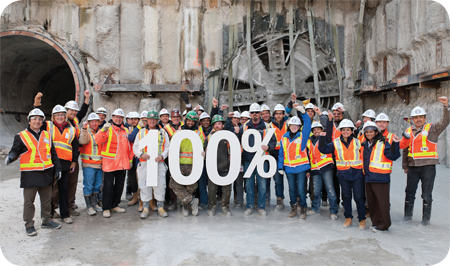
‘Holey’ ‘Moley’ tunnelling is complete!

photograph provided by The Toronto Transit Commission [TTC]

Here at vivaNext, we’re excited to announce that the Toronto-York Spadina Subway Extension (TYSSE) project has achieved another significant milestone – tunnelling for the project is 100% complete!

In the summer of 2011, the first Tunnel boring machine (TBM) “Holey” began boring from a launch shaft at the Downsview Park Station site. Since then, rain or shine, TBMs “Holey”, “Moley”, “Yorkie” and “Torkie” have been working hard and have collectively bored 6.4 kilometres of twin tunnels for the TYSSE project.

The final segment of tunnelling was finished when “Torkie” broke through the headwall at the Vaughan Metropolitan Centre (VMC) Station site, finishing the tenth and final tunnel drive for the project. This sets the stage for the next phase of work in the tunnels including installation of inverts and walkways, track, traction power, signals and communications systems.

With help from our friends at Toronto Transit Commission (TTC) we have some pretty cool photos and videos of the breakthrough to share with you on our website – see them here!

The TYSSE is an 8.6-kilometre extension of the TTC’s Yonge-University-Spadina subway line from Downsview Station to the VMC Station at Highway 7 in York Region.

Vaughan’s VMC station will be the northernmost station, connecting to a variety of other transit services. Situated in the future VMC development area, this station will act as a transportation hub, including convenient passenger pick-up and drop-off, a York Region Transit bus terminal, and connection to the viva rapidway running in dedicated lanes east and west along Highway 7.

Residents and visitors alike will enjoy the variety of transit options and mixed-use development offered in the VMC area. It will be a great place to work, shop or relax, and getting there will be easy whether you walk or ride transit.

Construction work for the TYSSE project is expected to be completed by fall 2016. Once the subway extension is completed, it will have 6 new subway stations (check out the TYSSE guide to station names) and 3 new commuter parking lots.

To learn more about the TYSSE project and sign up for construction notices, visit vivanext.com.

Categories
General Rapidways

viva rapid transit vehicles – providing comfort and style

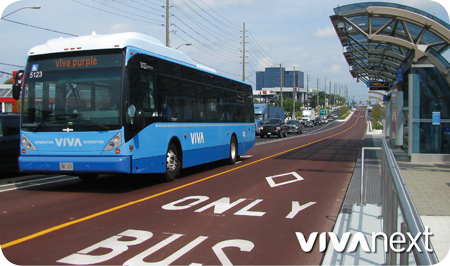
With the opening of the new rapidway on Highway 7 from Bayview Avenue to Highway 404, vivaNext has not only created placemaking structures but has transformed the way public transit is viewed.  The shelters are sleek and beautiful; the roadways are open and faster but most impressive are the buses that travel along these routes.

Nova Bus, based in Quebec, custom made and delivered twenty seven new vehicles in 2013 bringing the viva fleet to 123 vehicles; 40 foot vehicles and 63 foot vehicles.

York Region Rapid Transit (YRRTC) first procured viva vehicles in 2004 through an international request for proposals.  At that time the North American market did not manufacture any new, environmentally, comfortable buses and the contract was awarded to VanHool in Belgium.  In 2009 YRRTC once again put out a request for proposal for new vehicles and we were thrilled to have competitive submissions from North American companies.  After a rigorous process the contract was awarded to Nova Bus to manufacture the new vehicles maintaining the existing look and feel of the viva feet and all the comforts and benefits its customers have come to love.

The new Nova vehicles seat 56 passengers, plus the driver and have 2 mobility device stations, plus standing room.  Large platforms are located at both the front and back door for quick and convenient boarding.  A 32 inch wide electric ramp and a “kneeling/lift” floor system provides roll-on, roll-off access for those in mobility devices or pushing strollers.  This feature combined with the new near level boarding stations makes viva a full accessible transit system.  The new Nova has the accessibility ramp located at the front of the bus so that the driver can quickly activate and assist anyone requiring this feature.

All of the viva fleet comes with green light sensor systems which allow the GPS system to track their movements and allow central dispatch to update arrival times on the variable message boards at each station along the route.  This “smart technology” also has the ability to hold green lights or advance red lights at intersections if the vehicle is running behind schedule.

One of the great features of the viva rapid transit services is the soft, smooth ride which is provided by the state of the art-ride suspension on the vehicles.  The rear mounted engine allows for a quieter ride and helps keeps bumps to a minimum.

Canadians should be proud that our country is able to design, manufacture and deliver such quality transit vehicles and our customers are certainly appreciative of all the comforts they provide to their commute!

Categories
Construction General Rapidways

happy national housing day

Having a home is probably one of the most important and basic needs people have, and National Housing Day was introduced to remind us we should never take this fundamental need for granted.  This year National Housing Day is Friday November 22, and it’s being marked by special initiatives all across the country including here in York Region, where the Region is hosting a special social media and web-based campaign to raise awareness about the importance of affordable housing.

One of the biggest challenges facing our Region is that people have limited choice when it comes to affordable housing.  Traditionally a suburban region, many York Region residents have chosen to live in low-density single-family homes. As wonderful as that choice is for many, many families, there are some people who want – or need – other options.  And until recently, people who wanted to live in other forms of housing had very limited choices within the Region.

York has the lowest percentage of rental accommodation in the entire GTA. In some cases, that has meant people who want to live in York Region to stay near their families, or their jobs, have had to move away.  Whether it’s a young professional in their first job who has had to leave York Region to find affordable housing, or an older person who can’t manage a larger home on their own any more, too many people have found it hard to stay here at home.

Fortunately that’s changing, and VivaNext is a key driver that’s helping to expand the housing choices available here in York Region.

All along the viva routes, we’re seeing more and more housing being developed or proposed, including higher density developments near our new urban centres. Taking the direction from Regional Council, 35% of new housing in the centres and key development areas along the corridors have to meet affordability criteria, which is going to meet a key need here in York Region.

Building residential units along transit can help to reduce housing costs, since developments don’t have to include as much underground parking spaces.  This can reduce costs per unit significantly.  Another benefit of building near transit means people can get around without needing a car.  Whether you’re a young person moving out for the first time, or an older person who is happy to give up the keys to the car, that’s a significant advantage.

The best thing is that people who want to stay in York Region are now more able to, because rapid transit and long-term planning together are resulting in more choices, and more affordability.

So on November 22, give a thought to how much it would mean to you to be able to stay in the community you love, and to have a variety of affordable options to choose from.  We’re really pleased to be helping make that more possible, and wish you a Happy National Housing Day.


Categories
Announcements Community Events Rapidways

you’re invited to our Yonge Street open houses!

The next generation of rapid transit is coming to Yonge Street in Richmond Hill and Newmarket! In both communities, Yonge Street will be widened to accommodate dedicated rapidway lanes in the centre of the road, providing fast, reliable, convenient transit, while enhancing the area as an attractive destination for residents, businesses and visitors alike.

In Richmond Hill, the rapidway will extend 6.5 km and include 7 new vivastations from Highway 7 to 19th Avenue/Gamble Road. In Newmarket, dedicated bus rapid transit lanes will run along 2.4 km and include 3 new vivastations from just south of Mulock Drive to Davis Drive.

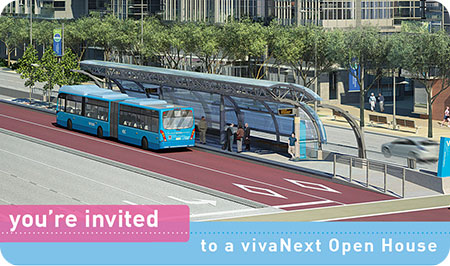
This project is moving full steam ahead with work beginning in 2014, and we want you to talk about it with us at our open houses this week! This is your chance to look at information boards and maps, and talk to vivaNext staff about what you can expect during the construction season ahead. You will also learn how a rapidway works and discuss the benefits it will bring to the community.

The same information will be available at both open houses. We hope to see you there, but if you can’t make it, you can subscribe online to receive construction updates and view all of the materials on our website after the meeting.

You’re invited!
Richmond Hill
When: Tuesday, November 19, 4-8 p.m.
Where: Richmond Hill Presbyterian Church
10066 Yonge Street, Richmond Hill

Newmarket
When: Wednesday, November 20, 4-8 p.m.
Where: Ray Twinney Recreation Complex
100 Eagle Street West, Newmarket

Learn more about the Yonge street rapidways ahead of the open houses by reading our Yonge Street project newsletter, and as always, feel free to contact us with any questions you might have at contactus@vivanext.com.


Categories
General LRT Rapidways

choosing the right form of transit

In September the Province set up an expert panel to look at how Metrolinx should be expanding transit in the GTHA, and to propose realistic options to pay for it.  The panel has just released their second discussion paper, and it’s well worth a read for anyone interested in getting beyond the rhetoric and really understanding the facts and issues.

Certainly the issue of what transit technology should be funded, and where it should run, is a subject that’s dominated the headlines for months and is of interest to everyone.  It’s understandable that so many have views on this subject, and it’s also reasonable to expect that the people doing the planning should listen to those views.

But in the final analysis, choosing a mode of transit – the main rapid transit options are subway, LRT, BRT and commuter train – shouldn’t be treated like a popularity contest. There’s just too much money involved.  Each mode of transit has its uses, benefits and drawbacks.  Those qualities are well known to transit planners, and need to be thoroughly and objectively analyzed in the context of local circumstances including passenger volumes, current and anticipated densities, employment projections, and present and future land use patterns.

Planners ideally will look at a range of transit modes to meet the needs of users across a region or area, with the primary consideration being a seamless system that enables passengers to make easy, fast connections.  That doesn’t necessarily mean the trip will be non-stop, or use the same technology the entire way.

This is a concept we all already live with, so we shouldn’t expect transit to be any different. Pretend you are taking a trip to a small island in the Caribbean.  You’d probably drive to the airport, then you’d get on a big jet, then most likely transfer to a smaller plane for the last leg, or maybe even a boat if you were going somewhere out of the way. You’d never expect the big jet to swing by your house to pick you up at your door, then whisk you non-stop to the tiny island.  Getting around the GTHA, depending on where you’re travelling from and to, follows the same logic.  Some riders may need to take surface transit, then transfer to one form of rapid transit – and then possibly to another mode to complete their trip.  The key point is to create a system that gets you there as fast as possible.

In a world where there’s only so much new money available for transit, careful decisions are needed to ensure final choices get the greatest number of people into transit, reducing gridlock on the road system.  The most costly option – subways – should be reserved for where it will do the most good, i.e. get the greatest number of cars off the roads.  Given that the need for new transit massively outstrips the money available, every single transit dollar needs to be spent wisely.

Professional analysis of facts has always been the basis for our vivaNext decisions. That’s why we’re installing BRT – the lowest cost form of rapid transit – along Highway 7, with the option to change to LRT when future volumes justify it.  On the other hand, the ridership and future employment projections do justify the cost of extending the subways north to the VMC, and along Yonge Street from Finch to Highway 7, so our plan includes subways too.

We’re proud of the system we’ve planned and are building for York Region, and are looking forward to the day when it will be connected to a system that covers the entire GTHA.  Now that’s something we think everyone will support.

Categories
Construction General

clearing the way for construction

If you’ve ever watched a new subdivision get built, you know how fast the work seems to advance.  Crews install utilities, build rough roads, and before you know it there’s an entire subdivision ready for families.  But building a new roadway in a densely built-up area is a completely different challenge: the work seems to go on for a long time, and progress is hard to detect unless you know what you’re looking for.

We’ve been working flat-out on Davis Drive for a year now, with dozens of complex activities underway or completed from Yonge to Leslie.  Even so, most of our effort so far has been about clearing the way, rather than constructing a rapidway and stations.

That’s the predictable reality of modernizing our roads and revitalizing Newmarket’s infrastructure, but it’s worth explaining why we can’t get going on roadway construction until these steps are completed.

A key work priority has been to build retaining walls to enable the road widening along the hilly contours of Davis Drive,  with that work now nearing completion.

And like all major thoroughfares, the foundations of the existing Davis Drive roadway are literally lined along both sides with existing critical infrastructure carrying water, telecommunications, gas, storm sewers and sanitary sewers.  Much of this infrastructure crosses the road at intervals and in many cases the various utilities are stacked up in multiple layers.  In addition, at the sides of the road are hydro poles and lines, transformers for electricity and telecommunications, fire hydrants, and a whole range of privately owned signs for businesses and commercial buildings.

As much as we love getting to the stage of putting down asphalt and constructing the beautiful viva stations, we can’t start this until the right-of-way is completely clear. Once we’ve built the retaining walls, we need to relocate everything else, one element at a time, further back and out of the way of the new wider roadway.  Relocating utilities is a complex task in itself, requiring a highly detailed level of coordination between gas, hydro, telecommunications and other utility companies.

Each type of utility has its own specific requirements about how and where it can be relocated, and which one goes deepest, which has to be installed last, and so on.  Each element requires its own program of design work and approvals.  And lastly, different crews are responsible for specific utility relocations, and there are rules about how closely they can work relative to adjacent work crews.

So the job of getting the roadway clear for construction is a huge, time-consuming and enormously detailed process – without even considering the new bridge and retaining walls that are underway. With multiple activities to be carried out in each block, some people may wonder why we’re not progressing more quickly.  But the reality is that we’ve already completed much of the work needed to clear the roadway, and widening has already started in some segments.  Because so much of the work is underground, there isn’t much to see yet.  But as crews start paving, it will feel and look like progress is starting to take shape.

Even though building a rapidway is a long process, people along Highway 7 in Richmond Hill and Markham can attest that the transformation does come to fruition. Residents and visitors alike are now enjoying the Highway 7 rapidway. We look forward to the day the Davis Drive rapidway is complete and Newmarket can enjoy the finished result too.