Categories
Construction Rapidways Stations

ITS – balancing the needs of all travellers

It’s stating the obvious to say that our roadways are getting slower because they’re carrying too much traffic – that’s the basic definition of gridlock, and it’s an increasing problem everywhere across the GTA.  But what can be done about it?  VivaNext is one part of the solution – if people have the choice of taking a reliable and convenient rapid transit system, there will be fewer cars on the road, and everyone will be able to get around more quickly.

But even with vivaNext, there’s still going to be a lot of traffic out there, and York Region doesn’t have room for more or bigger roads.  So what else can be done to help traffic move better?  This is where ITS comes in.

Although some people may think ITS is connected to “Information Technology”, in the vivaNext world ITS stands for “Intelligent Transportation Systems”. ITS is an international transportation-engineering discipline that is concerned with trying to improve the efficiency of travel, whether it involves the travelling public, commercial vehicles, or transit.  The basic assumptions behind ITS are that delays cost money, and more efficient travel saves money. This new technology is an absolutely critical, although low-visibility, component of the vivaNext program.

ITS is used to ensure that all parts of a traffic corridor’s infrastructure – the physical roadway’s design, lane markings and signs, traffic signal design and timing, and the brains that connect all these pieces – are designed as one coordinated system.  In a transit project ITS has an additional layer which is concerned with how the transit system is integrated into that larger system.

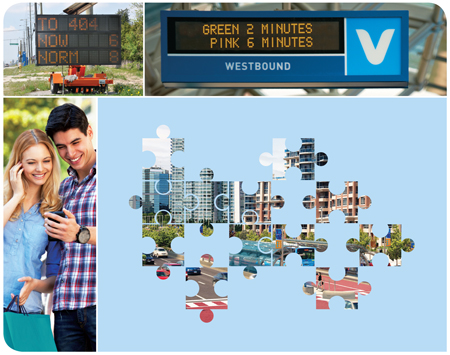
ITS is also about giving people accurate information so they can make better choices about travel, whether that means building roadside signage to alert drivers to upcoming congestion and suggest alternative routes, or giving transit riders real-time information about next bus arrivals.

Overall, ITS is about finding the perfect balance so that all the users of a roadway find it works better; making a roadway faster for one group of users cannot come at the expense of all the other users.  ITS starts with an understanding of who is using the roadway now and who will be using it in the future, and then develops strategies to make it more efficient for everyone.

Along Highway 7, we know that drivers and transit are the main users currently, but that’s going to change as development intensifies. The future Highway 7 will be significantly more urbanized, with more people living and working along the corridor.  That means there will be more pedestrians and cyclists whose travel needs need to be considered, in addition to car and truck traffic.  Helping transit vehicles stay on schedule is also a priority, since rapid transit can’t be rapid if it’s stuck in traffic.

These ITS strategies will balance everyone’s needs, to help everyone get to where they’re going as fast as possible!
 

Categories
Construction Live-work-play Rapidways Stations Urban Planning

countdown

As we get closer and closer to the time when the Highway 7 rapidway will be ready for service, our teams are working hard to finish all sorts of little details.  With much of the construction complete, we’re now focused on the final stages of completion and testing, and then getting ready for handover, when the system is officially turned over to York Region and YRT, the system owners and operators.

Handover means just what it says – it’s the moment in time when a system is handed over to the owner for care and custody.  From that time going forward, a system – which until then has been the responsibility of the Contractor/Design Builder – becomes the private property of the owner, and anyone needing access to do any additional work needs to get the permission from the owner for access.

Because the formal handover is such a significant development, especially on a major infrastructure project like the vivaNext rapidway, it’s important to ensure everything is in perfect working order.  The various steps involved in commissioning, which is the testing period that takes place before handover, vary depending on what is being handed over.  For example, with the fare equipment, we make sure the ticket vending machine [TVM] prints properly.  With the traffic signals, once they’re programmed the permanent signals are turned on and each phase is tested individually, and all the push buttons are tested to make sure they work.

Streetlights are inspected to ensure all the wiring is according to the drawings; that the bases are level, and the power connections are all correct.  The teams go out at night to actually turn on the lights, to ensure all the lamps come on and nothing is flickering.  Lighting is an important safety feature for both pedestrians and vehicles.

Viva driver testing is completed to make sure drivers know how to use the rapidway, its signals, and the stations.

Every single detail is inspected through a visual walk-down and a list of the things that still need to be finished or perfected is created with items graded from most serious to least serious.

Once handover takes place, legal ownership and responsibility is transferred to the owner, and the Contractor/Design Builder’s warranty period begins, just the way it happens when a homebuyer takes possession of a new house.

Handover in this case means some elements of the rapidway, like the rapidway, stations, boulevards and planters, are transferred to the Region.  Others, like the sidewalks and streetlights are transferred to the local municipality to maintain.

Ultimately, everyone who has a stake in vivaNext wants to see it work as designed, to provide a reliable, efficient rapid transit system and beautiful streetscape.  Because, at the end of the day, the ultimate owners are the people who are depending on it to work well: the public of York Region and we all want this to be a system to be proud of.


Categories
Rapidways Stations Urban Planning

driver training in progress

We’re really counting down the days to the start of vivaNext rapidway service, and we know you are too: being able to get on board a viva bus and zip past congestion is going to be a wonderful advantage for York Region transit users.  So you’ll know we’re really in the final stretches once you see viva buses out on the rapidway starting this week, which is when York Region Transit (YRT) starts the training process for operators and other staff.

YRT is doing training in two stages, with the first stage during the week of July 29 and the second stage over two weeks starting August 5.

In the first stage, training will be provided for everyone who will need to be familiar with the rapidways, the stations and equipment.  We will have vehicles out on the rapidway, taking customer service staff and other YRT staff along the rapidways and spending time at the new stations.  This will give staff a chance to really interact with all the new features so they’ll be ready to provide support to the public once the system is open.

During this time YRT will also be working with emergency services (police, fire, ambulance) to help them become familiar with the rapidway and safety features at the stations including the emergency call button.  Emergency services personnel will be familiarized with access points where they can enter and exit the rapidway, and in the future emergency services vehicles will have the option of using the rapidway when responding to calls.

The actual operator training begins the week of August 5 and will go on for 2 weeks, running from 8:00 AM to as late as 9 PM some nights, seven days a week.  During this time you can expect to see quite a lot of viva buses running up and down the rapidway, stopping at stations.  They will be clearly marked as YRT Training Vehicles to avoid confusion.  The training will focus on entering and exiting the rapidways, especially entering back into mixed traffic at the east end, and exiting the rapidway at the west end and crossing to the curb to service the Bayview Towers station.

Training will also focus on the new transit signals at intersections, which will provide a single green arrow for transit operations.  This signal will be clearly marked as being for transit only, but YRT operators will be trained to be cautious and on the lookout to make sure members of the driving public are obeying the signals correctly.

As part of their training, operators will spend time at the Chalmers station learning about the station’s layout and features, including the parking pad which will be used by support and maintenance staff for future station and rapidway maintenance and snow clearing.  Operators will also get training on the new fare equipment that passengers will be using once service starts.

Trainees will be taken out in groups of six or less, with one trainer to every three trainees.  They’re all experienced viva operators, so they know the route and the vehicle.   They’re really excited to get going, knowing that in just a few more weeks the rapidway will be open for service.  We hope you follow along with us through this blog series to get all the details as we count down the days!


Categories
Construction General Rapidways

turning on the Lights

Street lights are one of those infrastructure elements that the public may not give a lot of thought to, but in truth their design contributes significantly to the overall streetscape.  And because our project is being used to transform Highway 7 East from a highway to an urban corridor, all the vivaNext design components including the street lights have been given a lot of thought.  But before design considerations can be focused on, safety is the first priority to be achieved by street lighting. Here’s an overview of the role lighting plays in the vivaNext vision, and the street lighting elements you will see installed on all the rapidway corridors.

Designing street lighting, like all the major elements in the vivaNext project, is used to achieve a combination of practical and design objectives.  Lighting is first and foremost a public safety consideration. There are strict national and local standards against which street lighting is designed including how much lighting is required for different conditions (for example, different measures are used to determine the lighting levels for roadways compared to intersections and sidewalks).  Once the levels are known, lighting designers will develop a design, which includes variables such as pole height, spacing and “lux”, which is the amount of light to be provided by the fixture.

Once the lighting design is done, streetscape design objectives can come into play in order to marry the technical requirements with the architectural priorities needed to achieve the desired streetscape “look”.  In the case of vivaNext, the streetscape objectives are for a modern, stylish and uncluttered look that will contribute to the feeling of the corridors as being urban destinations, and make them distinctive from other Regional roadways.

To achieve all these safety requirements and design objectives, we have selected a special street light pole and luminaire (the light head or fixture), and arm that holds the luminaire, to be used along all the rapidway segments.  The poles will be a little higher than the ones they’ve replaced (9.9 m high versus 8.0 m), and they’re made of metal with a dark grey powder-coat finish for long-wearing good looks (and less maintenance).  Unlike most poles which are octagonal shaped and tapered to the top, these are round and cylindrical for a sleeker, more modern look.  And the lighting head or luminaire on top was chosen to complement the sleek modern look of our canopies.

Under its good looks, the street lights have a photo sensor to automatically turn on and off when it’s dark.  And the bulbs – which are little larger than the light bulbs you have in your home – only need to be replaced every 4 years.

So next time you’re sitting at a stop light or at a bus stop and you’re looking at the beautiful new streetscape, you’ll know more about all the decisions that were needed to turn on the lights!

Enjoy!!


Categories
Construction General Live-work-play Rapidways Stations Urban Planning

what’s a rapidway?

The word rapidway is new to most people, but pretty soon it’s going to be a very familiar concept for people in York Region.  We’ve had lots of interest from people wondering how exactly the rapidway on Highway 7 is going to work once it’s in service this year, and whether it will result in any changes for drivers, transit users and pedestrians.  So to get you started, here’s a primer on some rapidway basics.  Then for more detailed information, check out this blog over the upcoming days and weeks, for lots more information about what’s being built and how it’s going to benefit all of us.

  1. Who can actually drive in the rapidway?
  2. The rapidway will only be used by vivavehicles.  YRT buses will continue to run in mixed traffic as they do now, and will continue to use their existing curbside stops.  The exception is emergency vehicles; fire, ambulance, police, who may use the rapidways to help them through traffic.

    Under no circumstances will cars or other vehicles ever use the rapidway.  We’ll have signs at the beginning of the rapidway in each direction, making it very clear that non-viva vehicles must not enter.

  3. How will I know how to stay off the rapidway?
  4. We’ve made it easy to see where the rapidway begins, by paving the whole rapidway with distinctive bright red asphalt (see my blog in the next couple of weeks on red asphalt). It will be very obvious where the edges of the rapidway begin and end. To make it even more obvious, a rumble strip has been installed along the edges of the rapidway. Driving over the rumble strip will produce a loud noise if a driver begins to edge into the rapidway by mistake.

  5. How will I make a turn across the rapidway
  6. We’ve designed several features that will make it very clear where and when drivers can turn across the rapidway. (look for my blog in the next couple of weeks for more description of the new intersections and traffic signals). Left turns will only be allowed at intersections, which will have well-marked turning lines painted on them. The rapidways will have their own dedicated transit signals for viva drivers, which will be clearly marked and separate from the left turn signals for all other drivers. Lastly, there will be a protected left turn phase, meaning that drivers turning left (or making u-turns) will get a separate green arrow on its own phase, before through-traffic is allowed to move.

  7. How will pedestrians get to the vivastations?
  8. Every station is located adjacent to a signalized intersection, with a clearly marked crosswalk to make it easy to cross to the station in the median. Because Highway 7 with the rapidway lanes in the middle is now wider than it used to be, some pedestrians may want to cross the road in two stages, going to the median on the first stage, and then crossing to the other side on the second stage.

So that’s the most basic primer on how the rapidway will work, but I know people have many more questions. Over the next few weeks, I’m going to post an ongoing series of blogs on all the features of the new Highway 7 rapidway. But in the meantime, we want to know what you’d like more information on. Help us out by filling in your priority topics in this simple survey:

    [poll id=”43″]
Categories
General Live-work-play Rapidways Stations Urban Planning

bringing a long-term plan for the future to life, one step at a time

With crews working on the finishing touches on the western half of the Highway 7 rapidway, we’re getting closer to the day rapid transit finally becomes a reality for York Region.  As much as we’re looking forward to celebrating this milestone, it’s only one (very exciting) step in a long path that started years ago, and is going to take time to complete.

There’s a lot of media coverage these days on the general need for better transit all across the Greater Toronto and Hamilton Area (GTHA).  We’re proud that York Region has been actively working to bring rapid transit to our region.  In 2002 the Region produced the York Region Transportation Master Plan and the follow-up Rapid Transit Plan, committing the Region to a blueprint of multiple transportation initiatives to be built over the next 30 years.

With approval to the Rapid Transit Plan, we got to work quickly.  In 2005 the viva team – our formal name is York Region Rapid Transit Corporation – first launched “QuickStart”, the first phase of viva service.  Viva offered enhanced features that made transit more comfortable and convenient, and put the customer first in a way that was new for a transit service in the GTHA. With ridership levels that have increased steadily, viva changed the way people in York Region viewed transit.

But while our new viva service was a major success and an important first step in encouraging people to try transit, designing the vivaNext rapid transit system was our longer-term priority. Since 2005, Provincial government policy has required that Ontario municipalities plan for sustainable, more intensive land use, and rapid transit is a key component to achieve that goal.  Anticipating this, the 2002 Transportation Master Plan directed that future growth in York Region would be concentrated in new downtowns in Markham, Newmarket, Richmond Hill and Vaughan. By building more intensively in these areas, there would be less pressure for growth in existing neighbourhoods and a reduction in traffic congestion.

These urban centres would be connected by transportation “corridors”, making it easier for people to get around the region. The vivaNext rapidways will be built along the corridors, providing connections across York Region and into the rest of the GTHA.

Much of the new development built around vivastations will be compact and mixed-use, providing housing, employment, retail, dining, services and recreation, all within walking distance of transit. Developments will also include more welcoming public spaces, attractive landscaping, and other amenities that will contribute to the centres becoming more dynamic destinations.

Our plan is well and truly underway, and rapidways are being built on Highway 7 in both the east and west, as well as in Newmarket. The Toronto-York Spadina subway extension is under construction, and the design for rapidways on Yonge Street are being finalized.  Great new developments are popping up all over the new urban centres across the Region.

So when the first rapidway on Highway 7 starts service this year, we’re going to be celebrating the implementation of the first phase of our transportation and growth management blueprint.

We have many more phases to deliver, but with such a clear plan to follow, people in York Region can be assured it’s going to come true.  Check out our construction progress so far.


Categories
Construction General Rapidways Urban Planning

let’s talk construction

There’s an old joke that there are two seasons in Canada – winter and construction. Like the weather, road construction in York Region can’t be avoided; it must be endured.  But we all know that once the projects are done, we can enjoy our refreshed streets and the opening of the improved viva service in its own rapidway.

There’s no doubt that road construction would be completed a lot faster if we could just block off the necessary sections and do the full width and length all at once. Understanding people still need to get around; we do our best to work around traffic.  This means work progresses more slowly; in addition to needing Mother Nature on our side, we have to use smaller equipment and work in smaller sections. This may result in every stage taking longer. For example, paving requires only a few hours, but new pavement can’t be travelled on right away.  We schedule our paving work carefully to try to avoid paving during the most congested times of the day.

And sometimes you may wonder why we’ve returned to an area even though it seemed like we were finished. In fact, what you’re seeing is that we are coming back to complete work which has to be done in a certain order or in layers. Everything has a sequence and a process to finish the job.

To minimize overall duration and immediate impacts to motorists, residents and businesses, crews sometimes work 24/7 – weather permitting. This enables work to be completed in an area or on a piece of the construction that has a higher impact so that crews can then move on to the next section.

The good news to remember is once the final paving is finished, the biggest disruption of construction will soon be coming to an end. Once construction of the vivaNext rapidway project is complete in that area, we can all enjoy our new streets and boulevards and the anticipated opening of the new viva rapidway service.

We appreciate your patience throughout construction. We’ll make sure you know exactly where and when any lane closures are going to take place, to help you minimize any inconvenience. Look for our emails giving you the latest updates on where we’ll be working, and how long our work will take. Click here to sign up for construction notices, and to get the latest on the paving on Highway 7.

Sometimes, making it through traffic is only a matter of being prepared for the congestion.  Here are some wise words and a few recommended tips to help keep your cool and pass the time.  And as always, we thank you for your patience.


Categories
Construction General Live-work-play Rapidways Urban Planning

Getting the GTHA Moving

Everyone is hearing a lot these days about the need for more transit in the GTHA, and how increasing traffic congestion is hurting our economy.  The Toronto Board of Trade puts a $6 billion a year price tag on the cost of congestion. But beyond the headlines, many people don’t really understand exactly how traffic congestion and the lack of transit hurts the economy, and why this issue matters to every one of us in this region – and even to the rest of the province and country.

To help connect the dots, I recommend a recent panel discussion held on TVO’s The Agenda, which covered the issue clearly and logically.  This discussion provides an excellent overview of the issue, in a non-partisan, objective way.  Click here to view the episode.

What I found most interesting about this discussion was how it was explained that the lack of transit hurts everyone, whether or not they’re transit users now, or even want to be transit users.  Even people living in small communities that aren’t experiencing traffic congestion  in fact are economically affected by it. The negative impacts of congestion  in the GTHA, given how important this region is to the economy of the entire country, truly do affect the entire country.  One large business that chooses to open up in the USA rather than in the GTHA due to concerns about congestion hurts all taxpayers in the pocketbook eventually.

Enjoy watching the show and let me know what you think.

Categories
Construction Going Green Live-work-play Rapidways Stations Urban Planning vivaNext.com

Working together to achieve transit success

You have heard us talk a lot about growth at vivaNext.  Managing growing communities and planning for the future are always top of mind. As the region that comprises nine local municipalities and is home to 1,084,000 residents, 29,000 businesses and 495,000 employees, York Region is the fastest growing region in the Greater Toronto Area. We are always striving to identify key opportunities to improve upon and expand rapid transit plans to support the Region’s increasing population.

The successful execution of the vivaNext rapid transit plans rely on collaboration. While collaboration seems like a long word that has enough syllables to leave you tongue-tied, to me the definition is simple – working together as a team. At vivaNext we strive to work hand in hand with all our stakeholders and neighbours. With open dialogue and information exchange we do our best to listen and address comments and concerns.

Our rapidways are being built along the Region’s busiest corridors where urban development is taking shape. Check out a few municipal videos showcasing local growth.

VivaNext is proud to be bringing York Region an exceptional transit system that will connect it to the Greater Toronto and Hamilton area.

Categories
Construction Live-work-play Rapidways Urban Planning vivaNext.com

The Growth Plan

York Region is growing and vivaNext is the plan to bring the next generation of rapid transit to service that growth. Funding has been granted for several projects within the plan, including bus rapid transit [BRT], a subway, a bus maintenance facility and bus terminals. But where does that plan start? In general, it starts with vision, professional expertise, time, money and a commitment to stick to the plan.

But to be more specific, like all really important initiatives, the starting point for a successful transit program is doing in-depth planning to assess the Region’s population trends, long-term growth forecasts, transportation and development patterns, and economic development goals.

The overall need for rapid transit and the specific projects that together make up vivaNext were first identified in the Region’s Transportation Master Plan, then thoroughly evaluated through a series of Environmental Assessments.

Consultations with approval agencies, such as conservation authorities and local heritage committees, as well as the broader community, including employers, ratepayer groups and chambers of commerce, also provided important input.

This multi-year planning process has involved many levels of professional expertise within and affiliated with York Region and our local municipalities, and is proof of our communities’ long-range stewardship to meet our future needs.

Once the planning is complete then the work of building the transit network begins. Work that requires a logical and disciplined approach, to identify which pieces need to be built first, forming the network’s backbone, and which components can come later. Construction also has to be carefully staged, to minimize the disruption to communities, businesses and travelers.

That logical progression has informed how we’re staging the construction of vivaNext, with the added complexity of planning for the greatest amount of connectivity between our network and the larger GTA transit network as it expands.

Our overall priority is to improve the transit network at every step, so that we all can benefit right away from having more transit choices and a welcoming streetscape.

All currently funded segments will be completed by the end of 2018. But that won’t be the end  – with vivaNext’s established success in delivering projects as planned, we hope to obtain new funding to complete the remaining segments of the network, including additional rapidway segments and the extension of the Yonge Subway to Highway 7.