Categories
Construction Rapidways Stations

Building for the future: here comes the first Highway 7 rapidway station

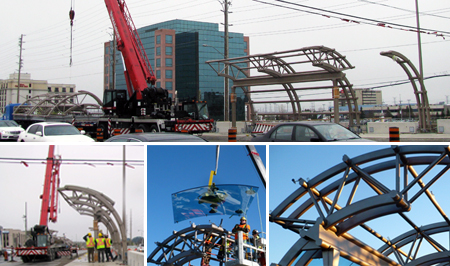
Installing vivastation canopies along Highway 7If you’ve been driving along Highway 7 East lately, you’ll notice an exciting development taking shape on our Highway 7 rapidway: the installation of the first of 22 vivastations.

And like everything else on the vivaNext project, the station that we’re going to be building in the median at Leslie and Highway 7 is the product of literally years of design, planning and preparation. Here’s a primer on the stations, and how they’ll be installed.

Like their predecessor at Warden Station on Enterprise Boulevard, our vivastations along Highway 7 are going to be beautiful, strong and very functional. The curved viva blue glass that makes up the canopy is surprisingly rugged – this glass is curved, tempered and laminated for strength, which prevents it from breaking into sharp pieces if it is cracked or broken. Reliability was our first priority in sourcing the manufacturer: our glass panels are actually being made by the company that makes nearly half of the world’s windshield glass.

Although the canopy is made up of nearly 100 individual panes of glass, each will be connected to its neighbour by small fasteners, known as “spiders” – so visually, the glass will look like it’s all one piece.

Supporting the glass underneath is a three-piece structure made of Canadian-fabricated steel, constructed just outside of Paris, Ontario. With durability in mind, the steel will be finished with a high-quality automotive-grade paint to minimize long-term maintenance costs.

Before the station components are delivered, a concrete platform is poured and set, and the connections built into the platform are prepared.  Then the canopy’s three steel structural sections are brought in on a wide-load tractor trailer and  installed. It takes about a week to align the sections perfectly and do some other prep, in advance of the glass being delivered and installed.

Each station includes two platforms/canopies – one for eastbound passengers and one for westbound passengers. Our schedule calls for the construction of one station canopy a month, with eastbound and then westbound canopies being built along the Highway 7 East rapidway throughout the rest of this year. There are a number of steps involved in getting the platforms ready before the glass and steel can be delivered; each platform requires about 12 weeks of work including excavations, installing electrical cables and concrete work.

One of the strategic decisions we made in the beginning for the vivaNext program is to build our rapidway segments consecutively, enabling our designers and construction experts to assess the experience of the previous segment and continually fine tune the design and construction methods. Lessons learned from our experience building the Warden Station have helped us find ways to modify the design, to make the canopies easier and more efficient to install. And because minimizing traffic impacts along the Highway 7 corridor is so critically important, our team has focused on finding strategies to install these huge canopies in a very small space with minimal lane closures.

Beyond providing rapid transit users with a comfortable and convenient experience, our vivastations are going to give a defining look and feel to Highway 7, as it becomes increasingly urbanized and developed over the next few years. We think that’s a milestone that’s really worth celebrating.
Categories
Construction

VivaNext’s underground world

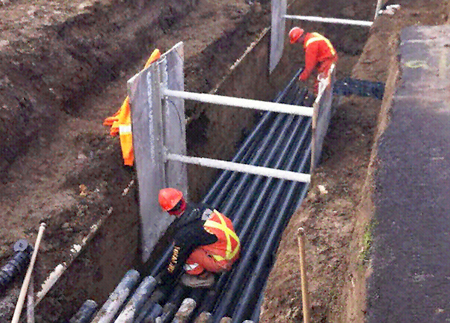
Underground conduit being installed

Recently at one of our weekly project meetings, I was thinking about how much time our designers and field engineers spend discussing and planning for things that are invisible to most people, and in many cases aren’t even directly related to our rapid transit project.

Every foot of our design work for the vivaNext construction project has had to take into consideration a dizzying array of underground utilities, their service connections to customers and residents, and unknown buried utility lines that may or may not be abandoned. Interfering with or changing any of those elements isn’t an option, because they’re part of the critically important infrastructure that everyone living or working in our Region depends on. We need to either work around them, relocate them, or bury them even deeper before we can do our own work.

So here’s a primer on everything located out of sight, in the underground world of vivaNext construction.

First, let’s think about all the things that everyone needs – water, electricity, heat, sanitation. In York Region, the larger the infrastructure the deeper into the ground it goes. All utilities need to be a minimum of 1 metre below ground.

Storm sewers are installed 2 metres below the curb while watermains are placed under the middle of roads at depths of 4 metres or more. There are two main water lines on the north and sound sides of Hwy 7, as well as storm sewers running up every street Highway 7 intersects.

Gas mains are installed 1.5 metres deep as close to property lines as possible, and when they cross under roads and creeks they’re as deep as 2.5 metres.

Telecommunication conduits can be installed in the boulevard at a depth of 1 metre due to their smaller size. As the population grows, so does the demand for telecommunication services, so quick access to these lines is important.

Then there are all the other things people want in their homes. How about a phone line? Or a line for your computer? And don’t forget the cable you need to watch your favourite TV show. During our construction projects, we’re coordinating with all the private telecommunications companies, as well as York Telecommunications Network (YTN) which provides connectivity to Viva bus stops. Where a lot of telecommunications lines need to be installed, they’re placed in a concrete encased duct bank.

And then there are the culverts, catch basins, manhole covers, oil grit separators for the storm sewers, and the fire hydrants. Add the underground elements for our landscaping, including tree soil cells and irrigation lines, plus foundations for bridges and other structures. That pretty much covers the main elements that are underground – and we didn’t even mention the utility work taking place above ground!

So if you ever thought it was taking a long time for us to begin building the above ground part of the project, you’ll know why we devote so much time to locating, designing around, and in some cases relocating, underground components before we can build on the surface.

Categories
Community Events

Visit us at the Markham Spring Home Show

Visit us at the Markham Spring Home ShowIf the mild weather we’ve had this winter isn’t enough to smile about, we can remember that spring is on the way. Just before the turn of the seasons, the Markham Spring Home Show will offer a preview of what spring will bring.

Along with the green grass and flowers, spring brings construction. So if you’re at the Markham Spring Home Show this weekend, drop by our booth and talk to us about what’s happening in 2012 in Markham, Richmond Hill, Vaughan and Newmarket. Like the changes you might make to your home, the rapidways will transform York Region’s key corridors into attractive places to live, work and play. If you have any questions or would like to look at some pictures, staff at the vivaNext booth will be happy to help.

The show is host to over 100 vendors, and celebrity speakers will include pastry chef Anna Olson and gardening experts Mark Cullen and Frank “Flowers” Ferragine. If you drop by our booth to chat, we’ll give you a lip balm to help protect you from spring weather. Hope to see you there!

Markham Spring Home Show 2012

When:
Friday, March 2  (1pm to 9pm)
Saturday, March 3  (10am to 6pm)
Sunday, March 4  (11am  to 5pm)

Where: Markham Fairgrounds
10801 McCowan Road, Markham, ON

Categories
Construction Stations

Winter work

Warden Station in Markham - Winter construction in 2010-2011

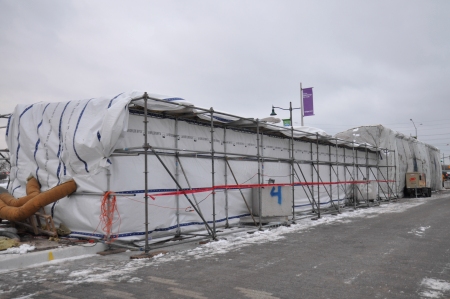
This winter has been unusually warm so far, but we probably can’t count on the balmy temperatures continuing all the way through until spring. But at the same time, our vivaNext rapidway construction schedule requires that we make good progress during winter. Although it might be surprising to see construction happening in winter, some work will be taking place – with a little modification to our warmer weather construction methods.

Over the winter, work continues along the boulevards on Highway 7 East, and we’ll build the foundations for the first three rapidway stations at West Beaver Creek Road, Leslie Street and East Beaver Creek Road.

Much of the work we’re doing involves concrete, which doesn’t actually dry but cures through its own internal chemical reaction that creates heat. If the concrete cools down too quickly, it won’t cure properly. So the crews must ensure the ground is warm enough before the concrete is placed, to enable the concrete to begin its own heating process. Once those chemical reactions get going, it keeps itself warm, and all we need to do is keep it insulated while it cures.

In areas where we need to excavate earth, we dig out the first few inches of frozen ground – with these milder temperatures the frost generally only extends down through the first six inches of soil. Then, using ground heaters, we blow hot air into the excavation to warm it up, and cover it with tarps. The concrete is then poured, and the tarps are kept on the concrete until it is cured. The concrete is tested to ensure it has properly set and meets our specifications.

By using these techniques, we will be able to continue work throughout the winter on the boulevards, and construct the six platforms at the three stations.

In the boulevards, we will continue to install the Cupolex® forms for the tree soil cells, which are excavated and then covered with concrete. On the station platforms, crews will augur shallow holes to pour the concrete caissons (foundations) for the platforms, then pour the concrete platform slabs on top of these foundations.

Plenty of work is happening this year for both Highway 7 East and Davis Drive, and there’s still lots of work left to do. But by continuing construction through the winter, we’ll be moving closer to finishing the Highway 7 rapidway.

Categories
Construction General

Davis Drive – noticeable change in 2011

Davis Drive in 2011

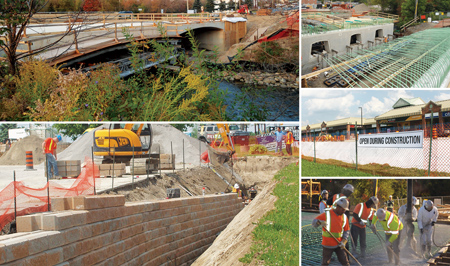
Davis Drive was a busy place in 2011, with lots of noticeable work done to prepare for rapidway construction. Rapidways will be built from Yonge Street to just past the hospital, and most of our work has been along this section.

Davis Drive will be widened starting in 2012, and we needed to do a few big things first: build retaining walls, widen the Keith Bridge, and relocate utilities.

Widening Davis Drive will mean moving sidewalks and boulevards farther apart. In locations along the south side of Davis Drive where the ground slopes toward the road, retaining walls were needed so that we can move utilities. Five retaining walls are now built using stone blocks or textured concrete, with railings to be added to walls over two feet in height.

A new section of the Keith Bridge was built in 2011, including 106 tonnes of rebar steel reinforcements, and 110 truckloads of poured cement. Even though the final touches are still to come, the historical architectural features are noticeable in the new bridge construction. The Keith Bridge will be fenced this winter, and traffic will move to this bridge section at a later date.

Utilities, such as hydro, gas, sewage, and telecommunication lines, need to be moved to prepare for road widening, and in some cases they needed to be relocated as part of the Keith Bridge or retaining wall construction. Geotechnical testing – examining the condition and consistency of road and boulevard surfaces – has also been underway along Davis Drive so that our engineers know what to plan for when they widen the road.

This winter our contractors are working on 2012 construction schedules and continuing with utility relocation and geotechnical testing. When warmer weather arrives we’ll be ready to begin widening Davis Drive, and you’ll begin to see the overall transformation of Davis Drive into a welcoming urban place.

Happy Holidays everyone – we’ll see you in 2012!

Categories
Construction General

Highway 7 East: snapshot of 2011

2011 snapshot

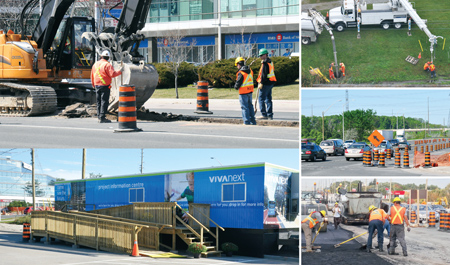
If you’ve travelled along Highway 7 between Bayview and Warden during 2011, you’ll agree that construction has been underway for most of this year. The Highway 7 East rapidway project has firm timelines, and our contractors have been working hard to stay on schedule.

Earlier in the year, we removed the median from the centre of the road, installed a new watermain and started to relocate the utilities. Recently we’ve been installing landscape irrigation systems and continuing to relocate utilities. The construction between Bayview and Warden is part of a segment of rapidway that will connect to Warden Station, the first fully-built rapid transit vivastation, that opened for service in March, 2011.

We’re just finishing up widening Highway 7 on both sides between Bayview and Highway 404, and we have important changes to traffic patterns at intersections for both drivers and pedestrians. These changes are part of the next phase of construction, providing workers enough room to build the rapidway, and platforms and canopies of rapid transit stations.

Starting next week at the intersections of West Beaver Creek Road, Leslie Street, and East Beaver Creek Road, a dedicated left-turn signal is being added. This new signal will enable drivers to turn left and make U-turns only when no other traffic is moving. Left turns will no longer be permitted when oncoming traffic has the green light.

Wider roads mean wider intersections, so a two-stage pedestrian crossing will also be added. Pedestrians walking at a normal pace will cross to the centre island and wait for the next signal before reaching the other side. Once the rapidway is complete, this centre island is also where Viva passengers will be able to access a rapid transit station.

This has been an exciting beginning to an overall transformation of the corridor which will help shape our growing community for generations. We have many new goals to look forward to in 2012, and as we pass each milestone, the rapid transit network and welcoming streetscape will take shape.

Categories
Construction Going Green Urban Planning

New technology takes root: helping trees grow

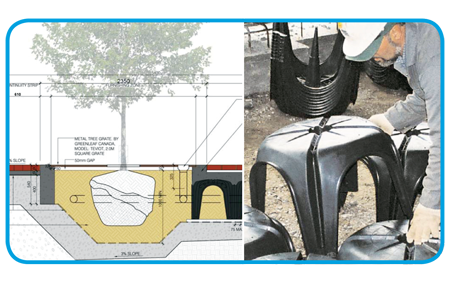
Diagram and photo of Cupolex

Among the beautiful benefits of the vivaNext project will be the improvements we’re going to make to the streetscape along York Region’s key corridors. A key part of those improvements will be carefully planned landscaping, including street trees planted at regular intervals for beauty and shade. Ensuring those trees survive in a tough urban environment is always a challenge, which is where science and technology come in.

Fortunately, our Landscape Architects are up to the challenge, and have tricks up their sleeves to keep our trees healthy and growing strong. To begin with, choosing the right tree is critical. Street trees, especially ones along roads carrying a lot of fast-moving traffic, need to be the kind that can stand up to salt spray and pollution from vehicles. Street trees also need to be relatively drought tolerant, and able to thrive without daily maintenance.

To meet these needs, our Arborist and Landscape Architects focused on a range of hardy trees, including different types of gingko, oak, maple, common hackberry, Kentucky coffee tree, ornamental pear and elm.

Once they’d solved the issue of which trees to plant, Landscape Architects turned to the other big problem facing urban plantings: large trees need a lot of soil around their roots. In a boulevard, there’s only so much room for soil, so trees generally don’t have the underground space they need to grow strong roots and take in nutrients. Our team is using an ingenious solution called “soil cell technology.” This refers to the cutting-edge approach of constructing a rigid form underground that can be filled with soil and then covered up by sidewalks or even roads.

Our soil cell technology is called Cupolex®, and was originally designed as a technique to provide a solid underground framework for ductwork and cables. At first glance it looks like a plastic patio table, with hollow legs at each corner. A series of these patio tables are installed underground, with their legs interlocking, forming a large honeycomb shape – a soil cell – surrounding where the tree will be planted. Then concrete is poured into the legs and over the top, creating a hard, self-supporting shell strong enough to support the weight of vehicles. The boulevard and sidewalks are constructed right over top, with openings left for planting trees. Special access hatches and irrigation pipes are installed for future tree maintenance, and then nutrient-rich soil is blown in, and trees are planted in the openings.

We’re not talking a regularly sized planter full of soil: each soil cell holds at least 16 cubic metres of soil. And each cubic metre is about the size of a stove, so imagine 16 stoves worth of soil for each tree! A typical dump truck holds 8-10 cubic metres, so each tree is going to get more than a dump truck of soil. That’s a lot of soil, and it’s really going to help our trees’ survivability.

Our vivaNext pledge is to do the best planning now, for a beautiful and functional rapid transit system and streetscape. Creating healthy, strong trees that can be enjoyed for generations is part of that, and it’s something we can all be proud of.

Categories
Surveys Urban Planning

When is a highway not a highway?

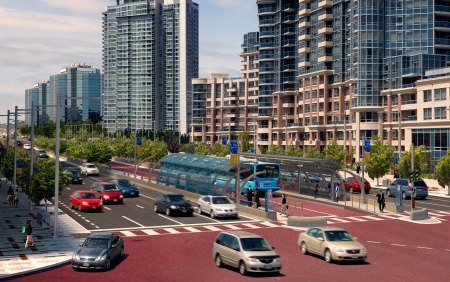
Inside Artist’s illustration of a transformed Highway 7

Here’s a question for you – when you hear the word highway, what comes to mind? Like most, you probably think of a lot of traffic moving at high speed along a roadway that is designed purely to get you from one place to another as quickly as possible. There may be the occasional stop along the way, but highway stops tend to be more functional than appealing destinations in and of themselves. A highway is for vehicles, large and small – but typically, not a great place for people.

A highway probably doesn’t bring to mind a welcoming, human-scaled streetscape, where people feel comfortable strolling along wide, beautifully-landscaped sidewalks and boulevards. Most highways don’t offer attractive shopping destinations, with store-fronts and restaurants near the sidewalk.

So why the question? Highway 7 is evolving and we want your thoughts and ideas about changing its name to something that better reflects its future.

Highway 7 is one of the most important roads in York Region and is the connector between urban areas in three of our municipalities. It stretches from Highway 50 in the west, across Vaughan and Richmond Hill to east of Donald Cousens Parkway in Markham. And certainly, in the past Highway 7 was all those things associated with the word “highway” – it carried a lot of traffic, and wasn’t designed to be a comfortable, attractive destination for pedestrians or local residents.

But change is coming quickly to Highway 7, and in the not-too-distant future there will be many sections of Highway 7 where people will want to shop, dine and relax. It’s all part of a larger plan – York Region is planning a system of regional centres and corridors, which follow the Province of Ontario’s Growth Plan for the Greater Golden Horseshoe. The vivaNext plan for rapidways and great transit connections along Highway 7 is also a big part of the change, with construction already underway for wide, welcoming boulevards and beautiful transit stations.

So, York Region is looking for suggestions for re-naming Highway 7. Considering the future transformation of Highway 7, what do you think it should be called?

It’s not a contest, so there are no rules – they’re just looking for your ideas. You can make your suggestions to York Region via Twitter (www.twitter.com/YorkRegionGovt), Facebook (www.facebook.com/YorkRegion), or you can post an idea here and we’ll forward it.

It’ll be interesting to see the name ideas people have for one of our most important streets.  Tell us what you think!

Categories
Urban Planning

Bus Rapid Transit: South America leads the way

Inside a BRT station in Curitiba – photo by www.ThomasLockeHobbs.com

The vivaNext rapidways project is one of a relatively small number of Bus Rapid Transit projects here in Canada, or for that matter in North America. There are BRT systems in Canada and the US, but the number of cities with BRT systems planned is relatively small, compared to the number of cities that would benefit from better transit.

What’s really interesting is how many cities around the world use BRT – cities with enormous populations and transit usage. Transit experts at EMBARQ (the Sustainable Transport wing of the World Resources Institute, an environmental think tank) estimate there are 120 cities around the world with BRT systems. And South America has taken to BRT enthusiastically, with BRT systems in 32 cities – more than a quarter of the total BRT systems around the globe.

One of the earliest BRT systems in the world was built in Curitiba, a large city in the south of Brazil with a population of just under 2 million within a larger metropolitan area. Other systems have been built all over South and Central America, including in all the major cities like Guatemala City, São Paolo, and Bogotá. There’s no doubt those systems are a spectacular success – transit ridership numbers in South American cities are huge. The Curitiba system carries a whopping 2.3 million riders per day, using 72 kilometres of median bus rapidway. Or how about São Paulo, with 104 kilometres of bus lanes, and a daily ridership of 5.7 million!

Besides a convenient way to get around, cities with bus rapid transit have been shown to have reduced commute times, lower tailpipe emissions and fewer traffic fatalities. And a key part of the success of these successful systems is that transit was built early on, and the surrounding land use was shaped by rapid transit. People became accustomed to taking transit, and transit-oriented development followed.

It’s exciting to think of the benefits vivaNext rapid transit projects will bring to our region. We know that there are differences in climate, landscape, and culture between South and Central American cities and York Region, but there are examples of BRT elsewhere in the world, and I’ll talk more about those next week.

Categories
Construction

Our pledge to you

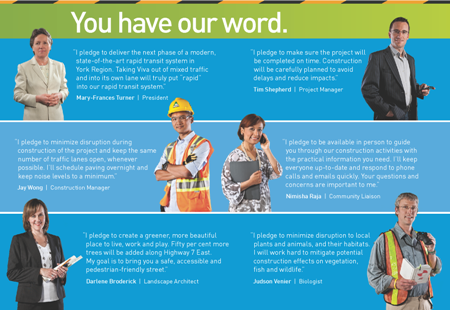
Click here to see the Pledge campaign poster

You probably can guess that I’m very proud to be involved in our vivaNext rapidway construction project underway on Highway 7. I believe – as does everyone who works here – that this project is going to be great for York Region.

We thought people in York Region might find it interesting and reassuring to meet some of the professionals who are part of the vivaNext Highway 7 East rapidway project, and to hear what those individuals personally hope to achieve through their own work. This is the thinking behind our “Pledge” campaign, which you may have seen in posters or video.

The pledge campaign is our commitment to the community – that our design will reflect state-of-the-art technology and transit planning and that it will incorporate detailed urban design elements for beautiful and welcoming streetscapes.

Our construction project will be carefully planned and implemented to minimize disruption as much as possible, and to time the noise and delays for the least inconvenience for commuters, businesses and residents.

We are committed to being careful stewards of the natural environment while we work, to ensure we cause no harm to vegetation, fish or wildlife through the construction project.

And last but not least, we will be transparent and open in providing all the information people need while construction is underway. We will be available to anyone who has a question, comment or concern, through our Community Liaison, Nimisha Raja.

All of us working on vivaNext, whether we’re named in the campaign or not, are personally and professionally proud to be a part of building this state-of-the-art rapid transit system. And we want everyone in York Region to know you have our word on it.