Categories
Live-work-play

Summertime fun made easy on YRT\Viva

Summertime fun made easy on YRTViva

It’s already August, but the weatherman is saying that there’s still lots of summer to be enjoyed here in York Region. Happily, all across York Region there are lots of great ways to relax and cool down. Whether your idea of fun includes cooling off by a beach, watching the kids in a wave pool, or taking in a performance at a concert or outdoor theatre, we’ve got you covered.

And even better, you don’t have to get in a car to get there! YRT\Viva is a great way to get yourself to some summer enjoyment, whether you’re relaxing with friends, or taking the kids for an outing.

Want to have a picnic? Scare yourself on the biggest and fastest rollercoasters? Ride a bike on a forested trail? Or play a round of golf? Whatever your idea of fun looks like, the YRT\Viva Trip Planner makes it easy. You just put in the address you’re leaving from and where you want to go, and the trip planner works out the best route and gives you a schedule. It even has a built-in list of the major recreation destinations across York Region. Then grab your PRESTO card or bus fare and you’re on your way.

For some ideas, check out these links for recreation centres, pools, picnic parks and conservation areas, and then get out there and enjoy the second half of this amazing summer.

YRT\Viva Tripplanner: http://tripplanner.yrt.ca/hiwire

Lake Simcoe region Conservation Authority, conservation areas: http://www.lsrca.on.ca/conservation_areas

List of recreational activities available in Markham: http://www.guidingstar.ca/Recreational_Activities_in_Markham.htm

Website for your municipality – Markham, Newmarket, Vaughan, etc: http://www.york.ca/Municipal+Links/default.htm

Categories
Construction General

Working together to keep everyone safe

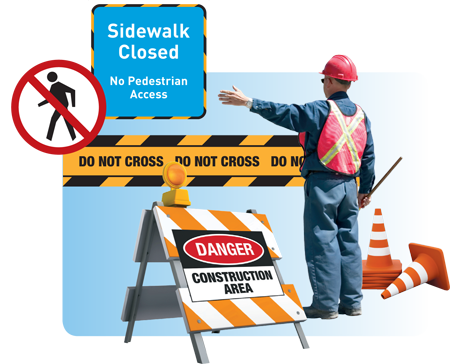
vivaNext construction signs

During the preliminary engineering phase of the vivaNext rapidway construction projects, as you might expect, our focus was on the design of our roadways, boulevards and stations. Now that we’re in active construction along Highway 7 and Davis Drive, one of our top priorities is safety – both for the public and for our workers. Our contractors have very detailed protocols for the steps they need to follow to keep their crews and members of the public safe, and ensuring safety is something we think everyone should take seriously.

The main challenge, as I previously mentioned in a blog about construction staging, is that our work has to happen on the edges and in the middle of some very busy roads. Closing all or part of Highway 7 isn’t an option, so our strategy there was to create as much separation as possible between active construction zones, and drivers and pedestrians. We created this separation by shifting the lanes away from the shoulders of the road, giving our workers more room to work, store materials and use heavy equipment.

To make sure everyone knows where the work zones are, we’ve posted signs and installed fences to clearly show that some areas are off-limits to pedestrians and drivers. We’ve put in place temporary sidewalks and temporary bus stops to ensure pedestrians have a clear path around work zones, and signs to make sure drivers can find temporary entrances to businesses and addresses. Every single crew member working for us is reminded and drilled regularly on what they need to be doing to stay safe, and keep you safe too.

Most drivers and pedestrians follow signs and stay away from construction areas, but sometimes pedestrians try to take shortcuts through work zones. It may seem like there’s little risk to doing this, but the reality is that work zones are filled with potential hazards for those who aren’t trained and wearing safety gear. Unexpectedly entering a construction site can put you and others at risk. Wires just below the surface, sharp objects, uneven ground and other hazards can lead to injuries. And the risk of walking near or around heavy equipment or vehicles, especially when they’re backing up, needs no explanation. Our crews know all the potential hazards, which is why they follow safety procedures and wear protective, highly-visible clothing, headgear and footwear at all times.

We hope every member of the public will respect this need for safety as well, and do the following:

>> Consider construction sites out of bounds, at all times – even when workers aren’t on site. Fences and no entry signs are there for a reason, even if you can’t see the reason.

>> Follow signs for temporary pathways or detours, even if the original route seems to still be available. We know your time is important and we wouldn’t create a detour if it wasn’t absolutely necessary.

As we go about our projects, we know that our construction disrupts the life of pedestrians, transit riders and drivers, and we do everything we can to do that as little as possible by keeping as many sidewalks, transit stops and traffic lanes open as we can, and minimizing detours and delays.

We hope that as you pass by our construction areas you’ll keep safety in mind too, and help us keep everyone safe.

Categories
General Rapidways Subways

York Region is ready to Presto

PRESTO card and fare machine

In London, it’s an Oyster. In Hong Kong, they call it an Octopus. Boston has its Charlie Card, and Atlanta loves its Breeze. And now York Region – along with other GTHA and Ottawa municipalities – is moving into the ranks of cities with smartcard technology for their transit system.

I’m talking of course about the launch of PRESTO this week in York Region on YRT\Viva services. PRESTO was developed through a partnership with the Province of Ontario, GO Transit and nine municipal transit partners in the Greater Toronto and Hamilton Area and in Ottawa, and will allow customers to ride on any participating transit system without pre-purchasing printed tickets or tokens.

Having access to PRESTO is great news for transit riders in York Region. Because PRESTO uses “stored-value” fare payments, customers can reload their card on the PRESTO website or at designated locations, and never have to worry about having a printed ticket or the right change. All you have to do is tap your card either on the PRESTO card reader at a vivastation before you board Viva, or on the on-board PRESTO machine on a YRT bus, and the system will automatically deduct the fare from your card’s balance (GO Transit riders also tap off at the end of their trip).

Smartcards are the way of the future for all great transit systems, and with good reason. These cards speed up the process of buying transit fares, they eliminate the paper waste associated with tickets, and they mean you’ll never need to rummage through your pockets for bus fare again.

One of the most important, long-term benefits is that, because smartcards often involve multiple transit services, they make it easier for passengers to travel across municipal boundaries. Instead of needing to purchase individual tickets for separate transit services, PRESTO is the only ticket riders will need to use on any participating system, including YRT\Viva, GO Transit (selected rail stations), Brampton Transit (ZÜM), Burlington Transit, Hamilton Street Railway, Mississauga Transit (MiWay), Oakville Transit, OC Transpo (Ottawa) and at select  TTC subway stations. And more stations and transit agencies are joining PRESTO throughout 2011 and 2012.

The PRESTO website and call centre (1-8-PRESTO-123) have all the information you’ll need to learn more about how PRESTO works in general, and where it can take you.

To introduce riders to PRESTO, YRT\Viva has representatives showing riders how to use PRESTO, helping them register online, and distributing up to 5,000 specially-priced cards. To get your new PRESTO card, check out the YRT\Viva website for distribution locations and hours.

Categories
Stations

PA systems – designing vivaNext to sound great

PA systems - designing vivaNext to sound great

One of the things I’ve enjoyed about working with vivaNext, has been the opportunity to watch the plan take shape for York Region’s rapid transit future. In our weekly project meetings, I get to see up close the incredible amount of thought and expertise that goes into planning every single aspect of our new system. Now that we’re into final design and construction on Highway 7 East (and will be soon on Davis Drive in Newmarket), detailed design decisions are being made on a whole range of topics. So from time to time, our blog will focus on a particular topic, to give you a sense of what’s happening and a sneak preview of the plan ahead.

This week, our engineers brought forward their initial thinking on the speakers to be used for the Public Announcement (PA) system we’ll have at each station. In my experience, PA systems in big public spaces don’t usually work all that well – it’s sometimes hard to actually understand what’s being said, even if the volume is cranked right up. Our engineers agree that transit PA systems are often either too loud or too quiet, and in either case the words are often garbled and unintelligible.

So this week they made a plan for how to design an ideal PA system for vivaNext. It needs to be designed to provide the right loudness (6 to 10 decibels above the ambient noise), provide uniform coverage across the listening area, and be clear and easy to understand.

To deliver on the first measure, there are sensors that will constantly measure the ambient noise levels – which will be higher during the day when multiple buses are at the station at once and traffic is passing by, and quieter at night when there’s less activity. The sensors can be connected to the speakers, so that the volume can be constantly adjusted to keep it at the right level. Being able to adjust the sound to just above ambient noise levels is very important, to ensure that people on the platform can hear messages, while ensuring it isn’t so loud that sound spills off the platform and disturbs others.

Placing the speakers is relatively straightforward, taking into account where people will be along the platform and in the enclosure, and also considering our vivastations’ curved canopies and glass and steel structure.

Measuring the intelligibility of the system (i.e., how easy it will be to understand what is being said) is more complex, and uses a modelling approach called the Speech Transmission Index or STI. The STI is one way that acoustical engineers have to model how sound will move around a space, taking into account echoes, distortion and background noise, to predict how clear the final messages will be.

Designing a first-class PA system is complicated, and like everything else on this project, depends on a wide range of technical and design expertise. Our team is more than up to the task, and I hope you find this gives you a sense of the kind of work needed to bring vivaNext to life.

Categories
General

Celebrating Canadian transit

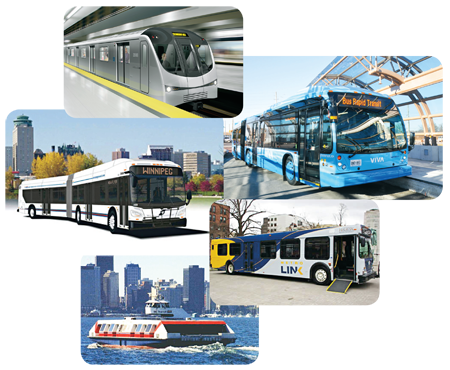
Examples of Canadian transit systems

With Canada Day just behind us, this is a great time to talk about the emerging enthusiasm across Canada for the importance of great transit.  If you’ve ever travelled outside of Canada to the world’s largest cities, there’s no doubt you will have seen how some large urban areas have really incredible transit systems – established networks that mean you truly never need to drive anywhere, and where transit is the easiest, fastest way to get around.  

But let’s talk about what makes good transit systems a priority, and how Canadian cities are increasingly investing in transit solutions.  The first factor that comes into play in transit design, is population density.  There’s no doubt that the more people who live or work in a defined area, the more transit can be effective.  Because Canadian cities don’t yet have the population of the really big international cities, they traditionally haven’t built the extensive networks that exist in places such as London or New York City. 

The problem is that this is a chicken and egg situation. Many people only want to live in an area where there’s convenient transit but transit planners – at least in the past – have often waited for an area’s population to increase before they invested in transit.   

Fortunately, many Canadian cities are realizing that they need to invest in transit before the population increases happen.  At the same time, they are increasingly encouraging the kinds of development that will support higher densities and that result in compact, pedestrian-friendly communities where people are more likely to leave their car at home and take transit.

Cities across Canada are building and expanding their transit networks, and using all sorts of different methods to encourage people to hop on board transit – from LRT and BRT, to ferries, subways and commuter trains, and even bike rentals. 

In Montreal, the transit provider STM has launched a new partnership called the Transportation Cocktail, which recognizes that there are all sorts of ways for people to get around apart from private autos. The Cocktail offers great deals combining tickets for transit and Bixi, the bike rental program.

Calgary’s C-Train is an enormous success, with the LRT in 2009 having counted one billion passengers since service was launched in 1981. It has the highest ridership of any LRT in North America. One of the success factors – apart from Calgary’s quickly growing population – is that rides in the downtown area are free!  Another great fact about the C-Train is that it gets all its electricity from wind power.  Now that’s a really small carbon footprint.

In Vancouver, the SkyTrain, which is a system of fully automated trains running mostly on elevated tracks, connects to a wonderfully diverse transit system that gives people lots of choices.  The entire system includes buses, trolley buses, a commuter rail system and the Sea Bus, a passenger-only ferry. 

The SkyTrain has been credited with helping to spur a significant amount of transit-oriented development to Vancouver – BC Transit says that more than $5 billion of private money has been invested within a 10–15 minute walking distance of the SkyTrain and SeaBus. 

Both Ottawa and Edmonton are currently extending their LRT lines, with the project in Ottawa involving tunneling through the busy downtown.

And what about the technology choice we’re using with Viva – BRT? 

Although it’s relatively new to Canada, cities all across the country are discovering the benefits of choosing BRT.  Some form of BRT has already been added to the transit services in many Canadian cities, with more extensive BRT services being planned or built across the country, from Victoria to Quebec City.

So in the future you’ll be able to visit cities across the country without having to get in a car, enjoying the sights by using our increasingly comprehensive transit services.  

If you’re interested in reading more about BRT in Canada, be sure to read this article from the Canadian Urban Transit Association.


Categories
Community Events Fun & Games

Help us wish Canada a happy birthday!

Happy Birthday Canada!

VivaNext teams will be out in the community tomorrow to proudly celebrate Canada Day at two different locations.

One of our teams will be chatting up festival goers at Newmarket’s at Fairy Lake for the Kanata Day festivities.  You can start the day with a pancake breakfast from 8am until noon at St. Andrew’s Presbyterian Church near the foot of Main Street in Newmarket. Then be sure to walk to Fairy Lake (Wesley Brooks Conservation Area), where there will also be all sorts of family fun including inflatable bouncers, an extreme bike demonstration, and live entertainment. At George Richardson Park on Bayview Parkway North, fireworks will begin at dusk.

Our second vivaNext team will celebrate the patriotism of the day at Richmond Hill’s Canada Day Celebrations. Be sure to drop by our booth in the Home Show area, 11am-5pm, and have fun with all the live performances, children’s games & inflatables, airbrush tattooing, teen zone, skating demonstrations, beer garden, and fireworks at dusk. It’s all happening at the Richmond Green Park and Sports Complex at 1300 Elgin Mills Road East.

There can’t be a better way to spend Canada Day than with the patriotic people of York Region. See you there!

Categories
General Press Rapidways

Transit ridership is way up: great news for everyone

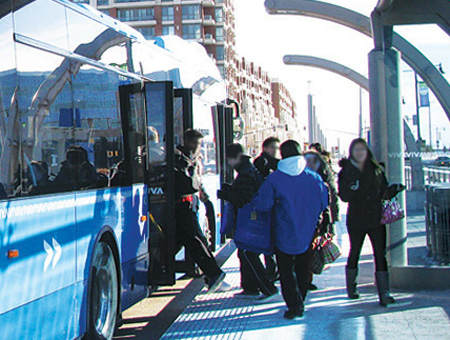
Viva passengers getting on and off the bus at Warden Station in Markham

If you’re reading this blog, you have likely already seen the news release on our vivaNext.com website, describing the steady increase in transit ridership in York Region. But just to restate, on June 14 we announced that Viva ridership has increased 26% since this service was launched in September 2005. Overall ridership for both York Region Transit (YRT) and Viva Bus Rapid Transit (BRT) has increased by 10.5% from January to April 2011, compared to the same period in 2010.

This increase is great news for a number of reasons, whether or not you’re a transit rider.

First, the more people take transit, the more successful our services will be – more riders means more revenue, which in turn can be put back into our route planning and frequency, making services even better for riders.

Second, more people leaving their car keys at home and boarding YRT\Viva means less air pollution for everyone. We all know how important air quality is to our health – especially during hot summer months.

Third, every loaded bus is equal to 70 cars. So even if you’re personally not a transit rider, every time you drive alongside a bus loaded with passengers, that’s 70 cars that aren’t in front of you. The result is less congestion and easier driving for people who need to get around by car.

The fourth, and in some ways the most important reason, is that increased ridership suggests a culture shift – a really important one for the future of this region, and how we manage growth.

There’s no doubt that the culture in York Region, in the past, was quite car-based. That’s not at all unusual in an area that expanded quickly as part of the GTA suburban growth; where new subdivisions were designed for people who travelled by car, and where it was convenient to drive to most places.

But that kind of urban design can only happen when there’s lots of room – room for big wide roads, room for huge parking lots, and room for all the homes and driveways. Not to mention room for all of the cars. With the growth coming to York Region, that design just isn’t sustainable – we don’t have enough room to accommodate everyone without making some adjustments. So going forward, our new growth will be managed with urban, higher density developments, clustered along major roads. These new developments are being planned to make it very convenient for people to live, work and play without needing to get in a car. Our vision is that people will be able to travel between their job, shopping and recreation while using transit.

The fact that our transit ridership is going up shows that our long-term plan is working, and that people are finding it easy to get around by hopping on board YRT\Viva.

With our rapidways and the Spadina Subway extension already under construction, and efforts being made to get funding for the Yonge Subway extension, transit is only going to get better and better, which is great news for all of us.

Categories
Subways

Launch of a connected region

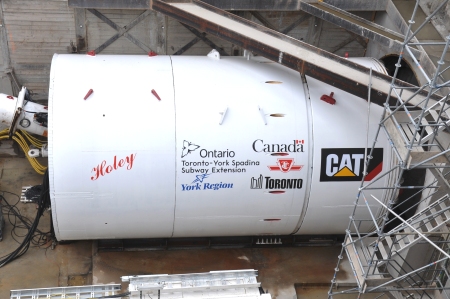
Photo of Holey, the tunnel boring machine for the Spadina subway extension

Friday was a momentous day for anyone who dreams of when it will be easier to get around the GTA. On Friday, we took the first concrete step towards a true regional transit system. This was the day when “Holey”, the massive tunnel boring machine, was officially launched to build a subway connection between Toronto and York Region. On Friday the clock started ticking to the day in 2015, when, without needing to transfer, we’ll be able to buy one ticket, sit in comfort, and travel in and around the GTA to anywhere the subway goes. A momentous day, indeed.

I’m talking of course about the official start of tunnelling for the Toronto-York Spadina Subway Extension. This new service, when it’s finished in late 2015, will extend the Spadina Subway by 8.5 kilometres from Downsview Station, via six new stations, to a new terminus at the Vaughan Metropolitan Centre development area on Highway 7. Vaughan’s new subway station will also link to the Viva rapidways along Highway 7, up Yonge Street and across Davis Drive in Newmarket.

It’s impossible to overstate the important role subway extensions play in connecting GTA regions, and how this first of two north-south subway extensions will change the way people take transit in the GTA. Until now, each municipality or Region has had its own separate rapid transit system, divided by geographic boundaries. In an area like the GTA, where so many people live in one municipality and work in another, having one connected rapid transit system will make life more convenient, more predictable, and much, much easier.

So Friday’s launch was a very big deal.

The subway, which is going to cost about $2.6 billion, is being paid for by the federal government, the provincial government through Metrolinx, The Regional Municipality of York, and the City of Toronto. A joint Toronto-York project team is collaborating to complete the project, and the engineering logistics of how the subway will actually connect to the Viva rapidways in Vaughan is a whole story unto itself, which I’ll write about soon.

We know from research that people love the idea of being able to commute by public transit, if they’re offered a fast, convenient and reliable alternative to driving. So extending subway lines will make a lot of people very happy.

“Holey” will soon be joined by her tunnel boring machine partner “Moley” to tunnel northwest from the Sheppard West launch site toward the Finch West site at Keele. Their twin cousins “Yorkie” and “Torkie”, will soon begin tunnelling southeast from their Steeles West launch site toward York University. We’ll be cheering them on, and judging by the excitement of the onlookers and circling helicopters at Friday’s launch, we know people all across the GTA will be cheering too.

Toronto-York Spadina Subway Extension project: www.spadina.ttc.ca 
Subways in York Region: www.vivanext.com/subways 
The Missing Link – business case describing why a Yonge Subway extension should be considered a top priority: http://bit.ly/lFtNaC

Categories
General Rapidways

New fences make good neighbours

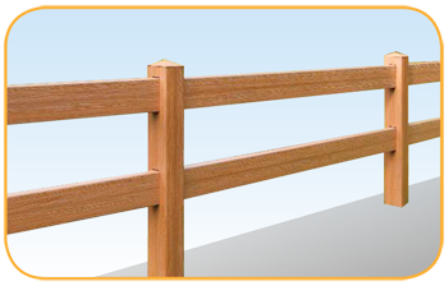
Example of paddock-style fencing

As we widen Davis Drive, one of our many priorities is to remember that for many people, Davis Drive isn’t just a busy street; it’s their home or workplace. Keeping that in mind, we’re doing whatever we can to be good neighbours while we build the Davis Drive rapidway.

That’s why last week we started installing paddock-style fencing around 19 properties on Davis Drive. We previously removed the buildings from these properties to make room for road widening, so they’re now vacant lots. Over the winter, they were surrounded by temporary construction fencing, but our intention was always that once demolition was done and warmer weather arrived, more attractive, permanent fencing would be installed.

Besides being attractive, the fencing is functional, keeping the properties secure and tidy. The new fences are set a bit back from the road to leave room for utility relocations and construction activity. As the project continues, we’ll use some properties to store construction materials, to stage crews and occasionally to park construction vehicles.

What will be done with the properties after the rapidway is complete? Well, that depends – each property is its own special case, with many factors for York Region and Metrolinx to consider and ensure the best possible use for the community.

In the meantime, your Community Liaison, Andrea Witty, is often out and about on Davis Drive, so if there’s something about the project that you’d like to talk about, please contact her.

Categories
General Rapidways

Why Bus Rapid Transit?

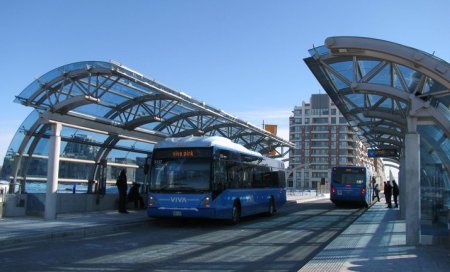
Warden Station: York Region's first built example of a rapid transit station

With GTA transit issues in the news so much lately, I’ve been asked why York Region chose to build Bus Rapid Transit instead of some other form of rapid transit. To help you understand how we decided to build vivaNext rapidways, here’s a bit of a primer on what BRT is, and why it’s great for York Region.

To begin with, Bus Rapid Transit (BRT) is defined as a public transit system that provides fast, frequent service, is able to move a lot of people, and runs on its own dedicated tracks or lanes. Other examples of rapid transit include subways and light rail transit (LRT). Some of the biggest cities in the world, including those with huge subway and LRT services, are increasingly turning to BRT as a key way to transport people quickly and reliably. And many major international cities, like New York City, are transforming their rapid transit systems by including BRT, at a fraction of what a rail system would cost. With limited resources and a lot of people to move, BRT is becoming seen as the smartest transit investment cities can make – like “a subway with a view.”

In general, the best BRT services have a number of things in common, including comfortable bus stations with amenities, well designed vehicles, a mechanism for rapid fare payment, use of Intelligent Transportation Systems (ITSs), dedicated roadway space, and frequent all day service. All aspects of a good BRT service are designed to work together to make travel faster than regular bus service. BRT vehicles need to be easy and convenient to enter, with close-to-level boarding, and rapid fare payment managed “off-board” (before passengers board). These elements help passengers get on and off more quickly, making the “dwell time” (the length of time the vehicle spends at a stop) as short as possible. And dedicated lanes through the most congested areas – as we will have here in York Region – are seen as the highest standard for BRT services.

Intelligent Transportation Systems (ITSs) are a whole story on their own, and one of the most interesting aspects of planning a BRT service. In a future blog, I’ll talk about these technologies and their huge impact on the performance of a BRT system.

Other rapid transit services such as subways or light rail may also have most of the same elements. But the main advantage offered by BRT is it can be expanded in segments as funding becomes available, and implemented quickly compared to other rapid transit services. Developing a rapid transit system in segments allows capital costs to be spread over time, which also leaves time to refine the design between each segment.

Being able to expand with funding, and the relatively fast timelines to implement, is especially important to York Region. More and more people are coming to York Region every year, and as much as this growth will bring many benefits, it also means our roads are getting more crowded – which is bad for everyone. We wanted to plan for a system that we could get up and running quickly and affordably.

The flexibility of BRT also works well for us, since development is taking place at different stages across York Region. Building BRT in segments means we can focus on the areas with the worst traffic congestion now, and then expand the system to service other areas as their population grows.

Everyone loves trains and subways, but those technologies don’t make sense in every situation. The decision to use a particular technology has to take into account the number of riders and local circumstances on the existing roadways. Subways cost a lot and are the best option where there are huge numbers of transit riders (such as south of Highway 7 on Yonge Street, or between Downsview Station and Highway 7 West in Vaughan). Most other transit routes in York Region don’t have the big city volume of riders needed to justify a subway. Light rail transit also calls for higher ridership numbers, but not as high as that needed by subways. Depending on future growth, in the future we may decide to convert our dedicated rapidways to LRT.

All in all, York Region’s BRT system will make travelling around York Region faster – at a price that we can afford. And with the first built example of a vivastation and rapidway section already in service, our new BRT system is going to be ready for passengers before you know it. We think that’s a plan to be proud of.