Categories
Announcements Community Events Rapidways

you’re invited to our Yonge Street open houses!

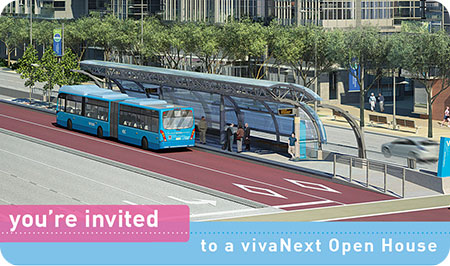
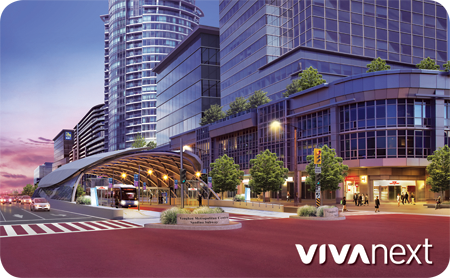
The next generation of rapid transit is coming to Yonge Street in Richmond Hill and Newmarket! In both communities, Yonge Street will be widened to accommodate dedicated rapidway lanes in the centre of the road, providing fast, reliable, convenient transit, while enhancing the area as an attractive destination for residents, businesses and visitors alike.

In Richmond Hill, the rapidway will extend 6.5 km and include 7 new vivastations from Highway 7 to 19th Avenue/Gamble Road. In Newmarket, dedicated bus rapid transit lanes will run along 2.4 km and include 3 new vivastations from just south of Mulock Drive to Davis Drive.

This project is moving full steam ahead with work beginning in 2014, and we want you to talk about it with us at our open houses this week! This is your chance to look at information boards and maps, and talk to vivaNext staff about what you can expect during the construction season ahead. You will also learn how a rapidway works and discuss the benefits it will bring to the community.

The same information will be available at both open houses. We hope to see you there, but if you can’t make it, you can subscribe online to receive construction updates and view all of the materials on our website after the meeting.

You’re invited!
Richmond Hill
When: Tuesday, November 19, 4-8 p.m.
Where: Richmond Hill Presbyterian Church
10066 Yonge Street, Richmond Hill

Newmarket
When: Wednesday, November 20, 4-8 p.m.
Where: Ray Twinney Recreation Complex
100 Eagle Street West, Newmarket

Learn more about the Yonge street rapidways ahead of the open houses by reading our Yonge Street project newsletter, and as always, feel free to contact us with any questions you might have at contactus@vivanext.com.


Categories
General LRT Rapidways

choosing the right form of transit

In September the Province set up an expert panel to look at how Metrolinx should be expanding transit in the GTHA, and to propose realistic options to pay for it.  The panel has just released their second discussion paper, and it’s well worth a read for anyone interested in getting beyond the rhetoric and really understanding the facts and issues.

Certainly the issue of what transit technology should be funded, and where it should run, is a subject that’s dominated the headlines for months and is of interest to everyone.  It’s understandable that so many have views on this subject, and it’s also reasonable to expect that the people doing the planning should listen to those views.

But in the final analysis, choosing a mode of transit – the main rapid transit options are subway, LRT, BRT and commuter train – shouldn’t be treated like a popularity contest. There’s just too much money involved.  Each mode of transit has its uses, benefits and drawbacks.  Those qualities are well known to transit planners, and need to be thoroughly and objectively analyzed in the context of local circumstances including passenger volumes, current and anticipated densities, employment projections, and present and future land use patterns.

Planners ideally will look at a range of transit modes to meet the needs of users across a region or area, with the primary consideration being a seamless system that enables passengers to make easy, fast connections.  That doesn’t necessarily mean the trip will be non-stop, or use the same technology the entire way.

This is a concept we all already live with, so we shouldn’t expect transit to be any different. Pretend you are taking a trip to a small island in the Caribbean.  You’d probably drive to the airport, then you’d get on a big jet, then most likely transfer to a smaller plane for the last leg, or maybe even a boat if you were going somewhere out of the way. You’d never expect the big jet to swing by your house to pick you up at your door, then whisk you non-stop to the tiny island.  Getting around the GTHA, depending on where you’re travelling from and to, follows the same logic.  Some riders may need to take surface transit, then transfer to one form of rapid transit – and then possibly to another mode to complete their trip.  The key point is to create a system that gets you there as fast as possible.

In a world where there’s only so much new money available for transit, careful decisions are needed to ensure final choices get the greatest number of people into transit, reducing gridlock on the road system.  The most costly option – subways – should be reserved for where it will do the most good, i.e. get the greatest number of cars off the roads.  Given that the need for new transit massively outstrips the money available, every single transit dollar needs to be spent wisely.

Professional analysis of facts has always been the basis for our vivaNext decisions. That’s why we’re installing BRT – the lowest cost form of rapid transit – along Highway 7, with the option to change to LRT when future volumes justify it.  On the other hand, the ridership and future employment projections do justify the cost of extending the subways north to the VMC, and along Yonge Street from Finch to Highway 7, so our plan includes subways too.

We’re proud of the system we’ve planned and are building for York Region, and are looking forward to the day when it will be connected to a system that covers the entire GTHA.  Now that’s something we think everyone will support.

Categories
Construction General Live-work-play Rapidways

bringing vaughan metropolitan centre to life

We recently posted a great blog on planning that talked about the link between transit and new urban communities. Given that tomorrow (November 8), urban planners from towns and cities in over 30 countries worldwide will celebrate World Town Planning Day, we thought we would take a moment to highlight another one of York Region’s amazing communities, and see how vivaNext transit projects fit into York Region’s planning vision.

In the Region’s Centres and Corridors strategy, selected areas in Newmarket, Richmond Hill, Markham and Vaughan are targeted to have new, urban “downtowns.” They will be vibrant, higher density, attractive destinations with a full range of amenities so that people can live, work, shop and play in the same community. These “centres” will be connected by transportation “corridors” that will make it easier for people to get around the region. That’s where we come in. Our vivaNext rapidways will run along the corridors, connecting the centres through transit and safe and efficient travel options for pedestrians, motorists and cyclists alike.

You can see the vision for one of these centres coming to life in the City of Vaughan’s new video about the Vaughan Metropolitan Centre [VMC] . Located in the heart of Vaughan, centered on Highway 7, between Highway 400 and Creditstone Road, VMC will be one of the largest and most ambitious development projects in the area’s history, and is a superb location for Vaughan’s new downtown.

In the VMC, mixed-use transit-oriented development is proposed along a tree-lined main street, including businesses, residences, entertainment and cultural facilities, as well as pedestrian shopping areas. The VMC area will act as a transportation hub, including convenient passenger pick-up and drop-off, a York Region Transit bus terminal, and viva rapidways running in dedicated lanes along Highway 7.

VMC will also be home to the northernmost subway station, as part of the Toronto-York Spadina Subway Extension [TYSSE], an 8.6 km subway extension from Downsview Station, northwest through York University and north to the Vaughan Metropolitan Centre. An entrance to VMC Station will be built on Millway Avenue, between Edgeley Boulevard and Jane Street to provide easy and efficient connections to other transit services.

With approximately 442 acres of development opportunities, VMC also includes:

  • Projected office development: 1.5 million SF
  • Projected retail development: 750,000 SF
  • Minimum of 12,000 residential units
  • Population potential: 25,000 new residents
  • Employment potential: 11,000 jobs of which 5,000 will be office jobs

It’s exciting to visualize how Vaughan will evolve in the years to come. To find out more about other vivaNext projects, visit our projects page.


Categories
Construction General

working together….

If you get vivaNext email updates, you probably recently read that Yorkie and Torkie the tunnel boring machines are munching their way closer and closer to Highway 7 and the Vaughan Metropolitan Centre (VMC).

This is great news, and means that the reality of a subway coming to York Region is getting closer every day.  But while the tunneling project is very high profile, vivaNext is also working hard to get ready for the subway opening at our VMC station.   Unlike other vivastations which we are building independently, the VMC station construction needs to be closely coordinated with the subway project, adding a whole new level of complexity.  Here’s a little background:

The VMC station will be located at Millway Avenue and Highway 7, as part of the VMC development area.  To provide passengers with seamless connections between the subway and the viva\YRT system, the subway station will be located on the lower level, with a concourse linking the subway to the vivastation above.

That may all sound relatively straightforward, but in fact there are significant engineering challenges involved with constructing a complicated building in the middle of a live highway, especially  when there’s a separate construction project going on directly underneath.  One of our top priorities is to ensure while we’re building the station to our own design plans, it also ties in to all the complex TTC systems down below so that everything works properly and in sync.

Some key elements such as escalators, elevators and stairways link the two structures. These need to be in place so the TTC can access the upstairs while they’re building their subway station down below. Escalators and elevator shafts aren’t very forgiving, so we need to work closely together to make sure all the elements line up perfectly.

Another challenge is that there’s not a lot of space to work given the location of the station in the middle of Highway 7.  From time to time we’re literally going to be working right on top of each other.  So we will be doing a lot of coordinating throughout the process to make sure all our contractors and subcontractors have enough room to do their jobs safely and in parallel.

The main priority for vivaNext and the TTC is that both parts of the VMC station are open when the subway service begins.  There’s a huge amount of work to be done between now and then, and we’ll be working closely with our TTC partners during the course of construction.

So stay tuned, and soon I’ll be giving you a proper tour of the VMC station design.  It’s going to be a showpiece that will be worth all the hard work.


Categories
Construction Live-work-play Rapidways

vivaNext – more to come

When it comes to the future of transit in York Region, you don’t have to look far. The first rapidway along Highway 7 east corridor is now up and running smoothly. With it came wide pedestrian-friendly boulevards, lined with trees and other greenery. The transformation taking place along the Viva routes will change how pedestrians, cyclists and motorists not only view the area in general, but get from A to B more easily, more safely and more efficiently.  Check out this 3600 virtual tour for a peak.

This is just the beginning of many miles of rapidway that are under construction or coming soon.  Here is an update of what’s happening.

Construction on Highway 7 East continues and crews are working hard from Highway 404 to Warden Avenue to widen the road, build pedestrian boulevards, plant trees and shrubs as well as installing utilities. This next segment of rapidway is expected to be completed in 2014.

Moving along Highway 7 west to Vaughan, you will see the vivaNext rapidway construction starting to take shape between Edgeley Boulevard and Bowes Road.  Over the last few months, crews have been working to remove signs, test soil and begin utility relocation to prepare for heavier construction.  Throughout the fall and winter, hydro, gas and telecommunications installations and relocations will continue in Vaughan.

Preliminary construction activity will also continue in other parts of Vaughan as vivaNext rapidway construction continues along Highway 7 West.   The Vaughan Metropolitan Centre [VMC] station will be completed in time with the Toronto-York Spadina Subway Extension [TYSSE].  Vaughan’s VMC station will be the northernmost subway station, connecting to Viva and a variety of other transit services, for a convenient and seamless experience.

In Newmarket, as you drive or walk along Davis Drive, you’ll see that construction is in full swing and the transformation is starting to take shape. The relocation and replacement of underground infrastructure in some segments on the south side of Davis Drive is complete. In those sections, road widening and preliminary paving has started preparing the roadway for future rapidways.

Also in Newmarket, crews are working to re-locate the Historic Union Hotel and its adjoining building to their final foundations this fall. Extensive culvert work at eastern and western creek is underway.  Work continues on the north side of the Keith Bridge.  Once completed all this work will help make your travel along Davis Drive smoother and more efficient, especially if you are on transit!

Over the next few years, future rapidways will be added to the Viva routes to better service customers and make travel times shorter by up to 25%.  We know construction is messy, but the end results are marvelous!

Categories
Rapidways Stations

making our stations accessible

Making public infrastructure, such as transit services, accessible is a priority, and the new vivaNext BRT design more than complies with all the requirements.   Formally, accessibility requirements are legally concerned with people with disabilities, but that’s actually only one component of how we’ve made the stations accessible.

The vivaNext commitment is to ensure everyone feels equally welcome on the station platforms and is able to board the viva vehicles, whether they have mobility or other physical limitations, or are pushing a baby stroller, or for any other reasons they might feel uncomfortable accessing transit service.

In addition to meeting the accessibility requirements set out in Provincial and local regulatory frameworks, we’ve gone to great lengths to design the platforms so all users have a comfortable and pleasant customer experience, and obtained advice and input from the CNIB and York Region’s Accessibility Committee during the design process.

Here’s what we’ve built into the new stations to ensure all users feel safe and comfortable.

  • The ramps to the platform have a shallow incline and handrails on either side, and there are no changes of grade or tripping hazards anywhere on the platform.   For people with impaired vision, the platform edge is clearly indicated through the use of domed tactile tiles in a contrasting colour.  At the primary bus stop location there are directional tiles which provide directional grooves going toward the bus, which will be helpful for people using canes for guidance.
  • People using wheelchairs will have no difficulties getting in and out of the heated enclosures, which provide wheelchair-turning radius inside, and have doors at either end to simplify access.  And the enclosures will have barrier free doors which have been designed to meet the highest accessibility standards including their button placement and operations such as door opening speed and how the door responds if it contacts an object.
  • We’ve included benches inside the enclosure and outside, complete with grab bars for people who appreciate a little help getting up and down.  And for anyone who dreads the chilly experience of sitting on a metal bench in a Canadian winter, we’ve planned for that too – the benches are constructed from durable Brazilian Ipe wood which will make sitting a little warmer in the cold weather.
  • The electronic ITS elements are designed to ensure using the equipment is equally successful for all our customers.   Our fare equipment is designed to be functional for people at wheelchair height or with other physical limitations, with angled screens, clear, bright graphics and large push-buttons.  The VMS will provide clearly visible information on buses, routes and the time.  We extensively researched and analyzed our PA system to make sure it’s clearly audible, and provides full coverage along the platform and in the enclosures. The notice holders for system updates are posted at the right height so they’re easily read whether you’re walking or in a wheelchair.  And we’ve installed large map cases at each platform, illuminated to make it easy for everyone to navigate their route.

Overall, our objective has been to provide a comfortable, safe and welcoming experience for all our transit riders with no barriers or restrictions.

Categories
Rapidways Stations

take a tour of the new rapidways on highway 7

Rapidways are now open on Highway 7 and they’re beautiful, they’re functional, and they’re going to make a huge contribution to the transformation of our communities.  Anyone travelling along Highway 7 in Richmond Hill or Markham has seen them from the outside, but here’s a peek of what they’re like on the inside.

The first thing you’ll notice as you cross to a station is how big and airy the canopy is at 28m (92’) long and 5m (16’) high.  The curved glass above the platform also provides both weather protection and a sense of space at the same time and satisfies long-term needs as platforms accommodate two viva vehicles at once and LRT (Light Rail Transit) in the future.  The platform is approached by a gently sloped ramp with handrails on both sides, making it fully accessible to all, whether they’re walking, pushing a stroller, or in a wheelchair or scooter.  Passing by the familiar viva fin and planted planter boxes, you’ll next come to an illuminated wall map of the YRT\Viva system.

Next on the tour is a bank of fare equipment, including a Ticket Vending Machine (TVM), a Ticket Validator (TV), and two Presto machines. Once you’ve paid your fare, you’ll move to the Fare Paid Zone (FPZ), which is clearly shown by being paved with a different coloured tile on the ground, as well as by a curved sign above.  We need to show this area as distinct, as YRT fare rules require passengers to have paid their fare before moving into the FPZ.

Once you’ve paid your fare, you’re free to make yourself comfortable on the platform until the next bus arrives.  We’re making it easy for you to know how long you’ve got to wait, with a large VMS (Variable Message Sign) projected from the canopy.  The VMS scrolls through all the upcoming arrivals, telling you exactly when the next bus will arrive.  Because the VMS system is connected to the GPS in our actual vehicles as well as the central transit scheduling software, it can be constantly updated to provide accurate and real-time information.

But if you decide you want to sit down on a bench, or get comfy out of the elements, we’ve made that easy too.  The fully heated glass enclosure is well lit, and accessed by two push-button automatic doors.  The heaters – which won’t be needed anytime soon, but you’ll like them come later this year, they’re like the infrared heaters in a hockey arena – will automatically turn on if someone enters the enclosure, and if the temperature in the enclosure feels lower than 10 degrees Celsius.  Multiple benches and garbage disposal units will add to your comfort.

The entire platform will be well lit, with lighting inside the canopy as well as on the platform.  And to enhance your feelings of comfort and security, the back of the platform is protected from the Highway 7 traffic by a barrier wall topped with a guardrail, and there are multiple security features including cameras and an emergency call button.

Last but not least, to help you stay oriented, wayfinding signage will show you where the buses will stop, and other features including the way to the crosswalk.

It’s hard to do the stations justice by written descriptions, so we have created a virtual tour to entice you to come out and try viva.

Categories
General Urban Planning

introducing the Bayview Towers

The Bayview Towers opened on September 1 for service, just in time for back to school. If you’re in the area near Highway 7 between Bayview and Chalmers/South Park you’ll have noticed two attractive buildings, sporting vivaNext symbols, built right next to the Bayview Bridge.   Here’s a description of the Bayview Towers, and how they’re going to make life more convenient and comfortable for York Region transit users.

The two handsome glass and concrete buildings, one on each of the north and south sides of Highway 7, are there to provide convenient access for people on Bayview Avenue wanting to connect to the viva system, and vice versa.  These buildings replace the stairs that used to be the only way people could make that connection.

Providing elevator access was always seen to be the ideal solution to ensure everyone would be able to move easily from Bayview down to Highway 7, but because elevators need to be located in spaces with constant temperatures and protected from the elements, we needed to create actual buildings around them.

That’s why we have built the Bayview Towers.  The buildings are not bus stations – there are curb-side vivastations on both the north and south sides of Highway 7.  The buildings are both fully accessible, and each has an elevator that will whisk people up to the level of the Bayview Bridge, as well as an interior stairwell.

Inside, the Towers are airy and well-lit, with glass walls making the interiors clearly visible to Highway 7.  With full security coverage including cameras that can monitor the entire building and emergency call buttons on all levels that connect directly to YRT dispatch, people will feel safe using the towers at all times.

At the top level, people will access the Towers via pedestrian bridges that enter onto the sidewalks on the Bayview.  Changes to YRT and Viva routes will go into effect now that the Towers are open, so check out the schedules before you head out.

All in all, we’re proud of these great new additions to our rapidway system, which are going to improve connectivity for everyone using Viva and YRT.


Categories
Construction Rapidways

colour coding the rapidway

As I’ve posted previously, Bus Rapid Transit is an increasingly popular rapid transit technology around the world [Bus Rapid Transit: growing around the world, Bus Rapid Transit: South America leads the way].   One of the ways to make BRT truly rapid, as we’re doing here in York Region, is to provide vehicles with separate lanes so they can move easily through congested areas.  And one way to make those lanes distinct without having an actual grade separation (which would require extra room as well as be much more costly) is to make them a different colour.  This is why the vivaNext rapidways are bright red, as you’ll have seen if you’ve driven along Highway 7 East recently.  These red lanes are for viva transit vehicles only and cars need to be careful not to drive into them for everyone’s safety.

But colouring asphalt anything other than basic black isn’t as easy as you might think.  Here’s what we’ve done to get our rapidways red.

Painting asphalt isn’t an option. Although it’s something we all take for granted, creating a long-lasting, durable asphalt mix for the conditions along a busy roadway like Highway 7 is actually a highly specialized science.  The surface on roadways that carry a lot of heavy traffic, especially traffic that is constantly turning and braking or accelerating at intersections, needs to be exceptionally strong to prevent cracking, rutting and shifting.  Canadian climate conditions including extreme temperature changes, hot sun, frost, and salting over the winter, all impose significant challenges.  Creating an asphalt mix to take these conditions without requiring frequent maintenance is something that specialized pavement designers work long and hard to achieve, with the technology constantly evolving.

So adding in the requirement to make it a distinct colour definitely adds to the complexity.

Using red pavers or bricks would not provide a sufficiently durable driving surface long term, and would be extremely costly to install and maintain.  One approach that is used when the colour is needed in very limited areas, such as crosswalks or bike lanes, is a material called “street print”.  But this material, which is actually a special top layer that’s heated right into the asphalt once it has been imprinted with a brick or paver pattern, would be too complicated to use along the full length of the rapidways (although we are using it for our crosswalks), and again would not be durable enough.

So the best approach is to tint the black asphalt, which we’re accomplishing in a couple of ways.   Asphalt is composed of a mixture of sand, stones and asphalt cement binding it together.  By adding reddish stones rather than grey ones, we can give an underlying red tint to the asphalt, especially as it wears.

The more complex adjustment is to add a special red pigment.  The challenge with the pigment is to be careful in how much we add:  too little and the colour doesn’t come through, but too much and the overall durability of the asphalt might be compromised.  The pavement design team has worked long and hard through a highly technical process to get the balance just right.

We’re delighted with their final results, which will give us what we need: a clearly defined rapidway that stands out from the regular traffic lanes, with a long-lasting and durable surface, at an affordable price.  Drivers need to remember as they make turns from side streets along Highway 7 to follow the white skip lines and not turn onto those red rapidways!  Although beautiful, they are red for safety too!


Categories
General Rapidways Stations

we can hear you, loud and clear

As I wrote earlier this summer, our engineers have worked hard to design the optimal public address system for your new vivastations.  Here’s what the system will include, and how good it’s going to sound.

Most PA systems are pretty frustrating in the garbled sound quality they provide.  We knew we wanted to do much better.  There’s nothing worse than knowing something important is being said, but not being able to understand it.

To make sure the new PA system is always audible, we started with an acoustic analysis study using special “Enhanced Acoustic Simulator for Engineers” (EASE) software. This study analyzed the two elements most critical to sound: Sound Pressure Level (SPL) and Speech Transmission Index (STI). The SPL, measured in decibels (dB), is concerned with sound magnitude and takes into account ambient noise levels – it is the relative “loudness” of a sound.  STI predicts how the equipment being used and the surrounding environment will affect the quality of the sound, and therefore how intelligible it is for you as you hear it.

First, the acoustic engineers needed to determine what effects our curved canopies and the beams and angles inside the station would have on the way sound is going to move around.  Secondly, the reflection of sound by the concrete wall, floor and glass was modeled. This analysis helped predict how clear the final sound will be on the platform and in the enclosure, and also helped determine the number and placement of speakers that will be most effective in achieving clear sounds.

Following this sophisticated modeling the engineers determined that the optimal number of speakers to achieve our goals would be 12 speakers located outside of the passenger enclosure, and another 3 speakers inside.

The next challenge was to work on the volume to be used by the speakers.  The problem with PA systems in noisy places is that the ambient noise can overwhelm the volume of the PA system, making it impossible to hear what’s being said.  Our solution is to use a speaker volume system that automatically adjusts when its sensors detect that the ambient noise has increased or decreased.

There are two sensors on each viva platform to measure noise level. This way, announcements should be audible whether there’s a bus idling in the station and trucks are moving past, or it’s nighttime and quiet.

The PA system will be used for recorded and live announcements from transit operations, such as emergency information or service changes, but will not announce bus arrivals although it does have that capability.

Although we’ve tested the system many times, we continue to monitor the sound levels now that operations have started.  We hope you have been out to test drive the first section of rapidways now open on Highway 7 and let us know if you can truly hear us, loud and clear.