Categories
Announcements

bragging rights

bragging rights

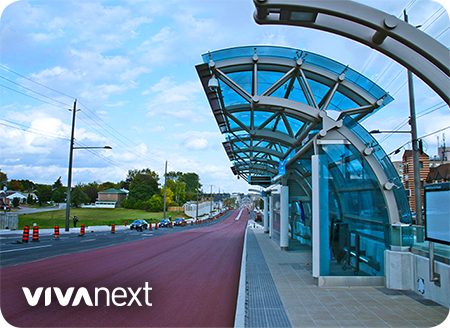
Well. We hate to brag, but we think those in the Highway 7 area would like to know – Roads and Bridges magazine has included the Highway 7 East rapidway project as #2 in their “Top 10 Roads” list for 2015.

The Highway 7 East project was recognized as a multi-modal “complete street” throughway, with the trade magazine noting the transit operations technology, the red-pigmented pavement, bike lanes and sidewalk landscaping.

Our office is located along the Highway 7 East rapidway, so we have to agree that the rapidway project has transformed Highway 7. West of Warden, the street has changed from being a highway with gravel shoulders, to being an attractive and safe place to walk, cycle, drive or ride Viva. The project included updated utilities, and has helped set the stage for the new developments along this important road.

Roads and Bridges voted the Highway 7 East rapidway project the second-best project in North America, and although it will always be number one in our books, we’re pleased to see it recognized by others in the industry.


Categories
Construction

sometimes construction is what you don’t see

sometimes construction is what you don't see

In many areas of the vivaNext projects, construction work is definitely visible – especially on Davis Drive and along Highway 7 West. In others areas – such as Yonge Street – it’s not quite so obvious. But work on Yonge Street has been going on this year for months, and it’s also starting up in phase 2 of the Highway 7 West rapidway.

Here’s some of what we’ve been up to – a very important part of construction – utilities!

there’s a lot going on underground

Upgrading the utilities to prepare for the growing population of York Region is a must. Plus, in order to upgrade utilities and widen the road for the rapidway, the existing utilities below the roadside have to be moved.

That’s because locating, upgrading and relocating utilities involves more than just building a road. And each utility has its own requirements.

utilities keep everything working

Utility work along the rapidway includes locating, removing and upgrading water mains and storm sewers, removing old copper cable and installing fiber optic cable for telecommunications, electricity, shutting down old gas mains and installing new ones, and it also includes upgrades and reconstruction to bridges and culverts and moving and upgrading traffic signals and street lights.

but first…

The first thing that happens along any new rapidway project is “utility investigations,” which means identifying where existing utilities are, to confirm what has to be moved. We can’t upgrade them until we find them, and some utilities can be as old as the road – installed before towns began documenting utility locations. So if you see crews digging small test pits along Yonge, you’ll know that’s a utility investigation where crews are making sure the utilities are where we think they are, and checking out what condition they’re in.

Next time you’re playing the game of Monopoly and you land on “Utilities,” feel lucky. “Utilities” are what keeps everything working at “Boardwalk,” “Park Place” and VivaNext!

For emailed updates about the progress of the various vivaNext projects: click here to subscribe.


Categories
Construction

paving in stages to get it done right

paving in stages to get it done right

As much as it has a huge impact on our day-to-day quality of life, it’s probably safe to say that roadway design is not very top-of-mind for most of us.  This is probably true, even for the part of the road that we all directly interact with every time we get in a vehicle: the asphalt paving that covers the surface.

Yet for anyone impatient for the last stages to be finished along the newly widened Davis Drive in Newmarket, it’s helpful to understand the paving process overall, and why this final stage of each rapidway project seems to take such a long time to complete.

Most roads in Canada are paved with the familiar black asphalt, which is a mix of a binding ingredient and gravel.  Asphalt is popular because it’s relatively inexpensive to install compared to concrete, wears well, and can be restored many times before the road needs to be completely rebuilt.  Given the cost and disruption involved with repairing or rebuilding a road, it’s critically important that you get the asphalt “mix” right, and put the asphalt down properly in the first place.

The first fact to understand is that not all asphalt paving is the same.  The wear and tear on a road will depend on the volume of traffic it gets, including how many vehicles are trucks or cars, and how fast they’re going.  Whether the traffic is generally driving straight, or is turning, or stopping and starting as is the case at a busy intersection, will affect the wear.  So asphalt mixes vary, depending on how durable it needs to be to stand up to the traffic it will carry. Different mixes have different installation requirements, including how long they take to cure before they can take heavy traffic.

The other important consideration with asphalt is that proper installation makes all the difference to how well it will wear.  There are a number of steps that have to be taken to ensure the durability of the asphalt, in addition to getting the mix right:

  • First, the gravel base that the top layers go over has to be in excellent condition. It needs to be perfectly smooth, level and compact, or else the top asphalt can crack and pothole more quickly.
  • The air temperature needs to be within a certain range: too hot or too cold, and the asphalt won’t last as long.
  • It needs to be installed in wide swathes extending across lanes, to avoid having too many joints.
  • It needs to be carefully tied in at side streets, to make sure the entire roadway is smooth and level.
  • The asphalt at intersections, which get extra heavy wear from vehicles braking, accelerating and turning, needs to be especially carefully installed.

The distinctive red asphalt on our vivaNext rapidways and intersections has its own requirements, and has to be laid down last, in a single layer, once the blacktop is completely set.

Working out a construction schedule that allows us to meet all these requirements before the weather gets too cold, requires that access to the roadway is completely restricted for short periods, within small segments.  Our team is working closely with the community to minimize the disruption as much as possible, although we know this stage is going to be challenging for everyone.

Getting the final stages done right has a direct impact on the long term performance of the road and the new rapid transit system.  As much as we want to be finished as soon as possible, speeding up the process simply is not an option. By building to the highest standards now, we’ll have a high quality road that will perform well for years to come.


Categories
Construction

final paving on Davis Drive is underway!

final paving on Davis Drive is underway!

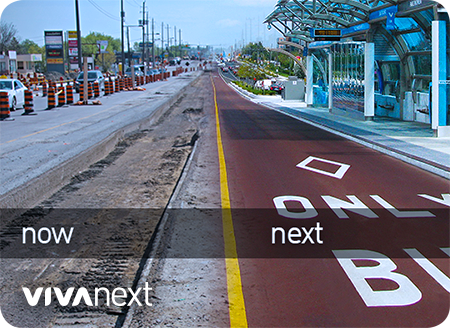
Final paving is here! This week you’ll start to see the distinctive red asphalt on the rapidway and intersections along the Davis Drive corridor in Newmarket. It’s exciting because final paving means that underground utilities and infrastructure work is complete, the road has been widened to accommodate the centre lane rapidway and the medians and curbs are in place. All these elements help define a new urban destination for Newmarket. This is a significant milestone in the transformation of Davis Drive.

If you travel along Davis on a regular basis, you’re already aware of the fundamental changes that have been made to the way people drive, walk and ride on the corridor. New intersections allow for protected left-turns and u-turns, and feature optional two-stage pedestrian crossings, and accessibility features like audible chirps to aid people who are visually impaired. For the eco-conscious, the greenery planned for Davis Drive and the connections to paths like the Tom Taylor Trail will make the sidewalks and boulevards inviting spaces for all.

It’s not just Davis that’s getting a shiny new coat, the side streets that connect to Davis will be paved at the intersections so that they tie-in nicely with the new road.

Even after years of planning, design and construction, the rapidway just feels more tangible and real when we apply our distinct red asphalt to the road. There’s something special about knowing that you’re contributing to the future growth and prosperity of entire neighbourhoods, towns and regions by connecting people to the places they work, shop and play.

We are already seeing the benefits of improved traffic flow and travel times along Highway 7 in Richmond Hill and Markham, and the YRT/Viva network continues to grow.

To get there is a messy process, there’s no doubt. But we are asking you to hang in there with us over the next month or so, and we hope that you’ll share our enthusiasm for the finished product.


Categories
Going Green

one with nature

see video: one with nature

As York Region transforms our key development areas from suburban locations to more urban one it’s important that we create attractive and welcoming public spaces. This means designing buildings with aesthetics in mind, considering the accessibility of civic spaces, public transit and incorporating the natural environment into the urban landscape.

It’s important to create urban settings that integrate natural elements for a number of reasons. It beautifies public spaces, and also provides health and economic benefits to the community. One way to ensure that York Region’s urban centres are one with nature is to invest in green infrastructure. This includes trees, shrubs, grasses, and other plants that will become a part of our urban forest.

Mature trees absorb large quantities of carbon dioxide, sulphur dioxide, ozone and particulates, cleaning polluted urban air. In addition, research suggests that investing in green infrastructure will result in improved health for residents; People living on Toronto blocks with 10 or more trees are less likely than other residents to report conditions such as diabetes, heart disease, high blood pressure or obesity. There is also documented evidence that investing in green infrastructure will result in increased property values, better business outcomes, and reduced energy costs [read our previous blog on the topic].

On top of our commitment to green infrastructure, vivaNext is committed to respecting the natural environment that already exists in York Region. Our work to extend bridges and culverts along the Region’s corridors includes natural restoration plans, which will create better conditions for wildlife and aquatic species. Intensification of the urban centres and corridors means that municipalities will be building up instead of out. With population densities increasing in these areas there will be less pressure for sprawl to reach farmlands and green spaces. Greenery of the future York Region will be a harmonious mix of urban forest and open green space – providing something for everyone!

Along the Highway 7 East rapidway, vivaNext has already planted 1,250 new trees and 10,000 new shrubs. To watch how this investment, and future investments, will benefit York Region check out our video.


Categories
Announcements

rolling out a new phase of rapid transit in Vaughan

rolling out a new phase of rapid transit in Vaughan

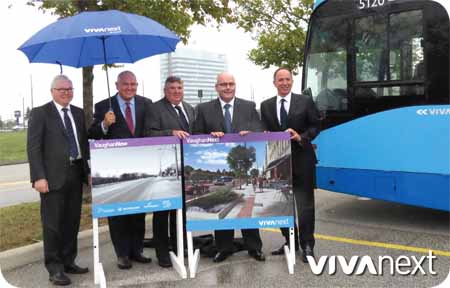
The next phase of Viva is extending both east and west in Vaughan and Richmond Hill. We were excited to announce this week that EDCO has been awarded the $333.2 million contract to design, build and finance the second phase of the Highway 7 West rapidway.

The first phase of rapidway is well underway in the Vaughan Metropolitan Centre [VMC], with the vivaNext rapidway between Jane Street and Bowes Road scheduled to open in Fall 2016, and the section west of Jane being coordinated with the opening of the Toronto-York Spadina Subway Extension [TYSSE].

phase two

Phase two of the Highway 7 West rapidway will emerge from both sides of the current construction. It will extend west from the VMC, over Highway 400 all the way out to Helen Street, and it will expand east to Yonge Street along the existing Centre Street and Bathurst Street Viva route.

making connections

Extending the rapidway will connect riders from Woodbridge, Concord and Thornhill to the Spadina/University Subway line at the new VMC subway station, and will also connect riders to the rest of York Region via the Richmond Hill Terminal at Yonge Street.

The project involves widening Highway 7, Bathurst Street and Centre Street to add 12 kilometres of dedicated rapidway lanes for Viva rapid transit vehicles PLUS 10 new vivastations, PLUS new bike lanes PLUS pedestrian walkways and sidewalks.

partnering with contractors

As with our previous rapidway projects, this is a public-private partnership. One key difference is that along with the design and build requirements, the contractor is required to finance this project. YRRTC will be the project manager, controlling and approving the design and construction, financial management, and community relations. Metrolinx will own the assets of the rapidway infrastructure, and YRT/Viva will operate transit on the rapidways, and maintain the stations. On regional roads like Highway 7, Centre Street and Bathurst Street, York Region will maintain the road and rapidway.

more than a third of York Region’s rapidways

This project represents more than a third of the total 34 kilometres of rapidways being built, and with this contract awarded, all of our rapidway projects are on the way, except Highway 7 East, which is done!

To learn more about the Highway 7 West, phase two rapidway project, and to sign up for updates, visit vivanext.com/subscribe.


Categories
Video

creating connections

video: creating connections - a day in the life of a rapidway rider

Rapid transit is making it easier for people to move about York Region, connecting them to the places, people and things that matter. With all the traffic congestion the GTA currently faces, rapid transit can be a relaxing and time saving convenience. But what does this convenience really look like?

Because Viva travels in its own lanes along the length of the rapidways, riders save time and enjoy reliable service. Rapidway riders experience, on average, time savings of 16 minutes per round trip on the Highway 7 East rapidway, compared to making that same trip in a vehicle. And considering most commuters who travel along Highway 7 East will make daily round trips along the stretch of the rapidway, saving 16 minutes per round trip really adds up. In fact, it adds up to an annual time savings of 64 hours – that’s over two days! And less time spent travelling means more time for the things that matter.

Along with the rapidways, growth continues in York Region with new residential buildings, jobs and businesses popping up in the towns and cities, and along our roads. This means that people living in these urban centres won’t have to travel far to access services and amenities. They can easily walk, bike, or hop on Viva for a short trip to get where they need to go.

Rapid transit is providing convenience, reliability, and freedom for people to move around York Region easily. Watch our new video, day in the life of a rapidway rider, to see how one transit user enjoys the perks of the Viva rapidway along Highway 7, now that it’s complete


Categories
Urban Planning

from suburban to urban

suburban to urban

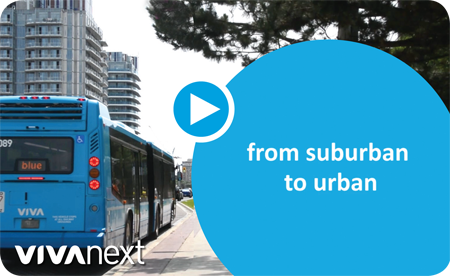
York Region’s urban centres are becoming vibrant locations for residents and visitors, growing with new urban cultural attractions – thanks to the support of a rapid transit system.

Exciting growth and new developments featuring modern architecture are popping up in the areas where rapidways are being built, including Vaughan, Markham, Richmond Hill, and Newmarket. Much of these developments are compact and mixed-use, providing new places to live and work right on peoples’ doorsteps. And the best part is that all these attractions will be conveniently located next to fast, reliable transit – making it easier than ever for people to connect within the Region. When amenities are close by and getting around is easy, a community truly feels connected.

As York Region grows, vivaNext is growing right along with it. Adding a rapid transit system with sleek, modern stations and pedestrian and cyclist-friendly streetscapes, contributes to the feeling of being in the centre of things. It also promotes alternative modes of transportation, helping shift residents away from the car-dependent culture toward a more urban, transit-supportive way of living. It’s wonderful to have transportation choices right on your doorstep. York Region is transforming and the future looks bright! Pictures paint a great picture – check out our video to see the changes unfolding.


Categories
Accessibility

it’s new, and it’s for everyone

it's new, and it's for everyone

One of the perks of building a new transit system is that modern technology can be included from the get-go. New transit systems are installed with the newest technology, in the same way that a new computer comes with new software, or a new house has to meet modern building codes.

Some of the new technology is embedded in the vivaNext rapidways – for example, as a film to strengthen the vivastation glass, or as an additive in the pavement. Modern GPS and transit signal technology help to keep the buses moving on schedule, and new government regulations ensure the system is accessible to all.

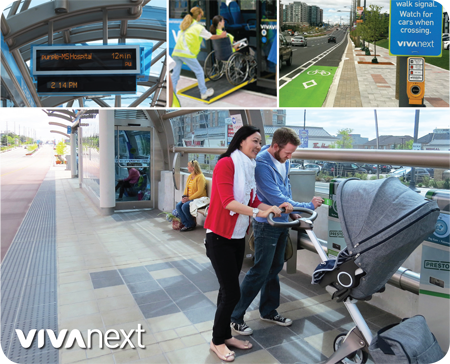
Aside from the new regulations in the Accessibility for Ontarians with Disabilities Act [AODA], there is also a new way of thinking – that our streets should be accessible to everyone. So we’ve made transit a priority. We’ve added bike lanes where possible. And we’ve added tree-lined sidewalks, and crosswalks with audible signals for pedestrians.

Viva has the technology in place to add audible announcements at vivastations, and Viva riders can see and hear when the bus is approaching their station. Each vivastation has a textured platform surface to help customers identify which part of the platform they’re standing on, and when they’re approaching the edge.

It’s new, and it’s for everyone. Whether you ride a wheelchair, use a cane, push a stroller or ride a bike, the vivaNext rapidways are for you.


Categories
economic & financial Urban Planning

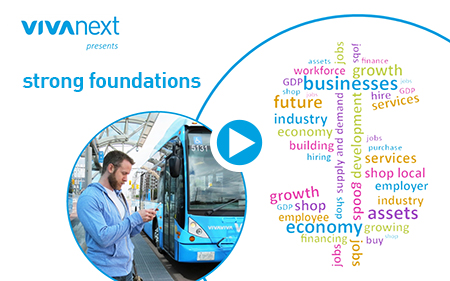
strong foundations

click to see the video: strong foundations

If you’ve seen the completed rapidway on Highway 7 East, you’ll know that the roadway has gotten a major facelift. VivaNext is building sleek, modern and welcoming transit stations and streetscapes throughout York Region. But that’s not all. During the construction of each new rapidway, older infrastructure is upgraded to lay a strong foundation for the social and economic development that will accompany a rapid transit network.

York Region’s population is expected to increase by 600,000 by the year 2041. As York Region grows into a more urban destination, it’s important to ensure that we have the infrastructure necessary to support a larger, denser population. Taking the time to replace infrastructure during rapidway construction allows us to support this growth, while also reducing future maintenance and repair costs. As the rapidways are being built, water mains, storm sewers, street lights, and other utilities are also being upgraded, expanded or renewed, and bridges and culverts are being assessed and rebuilt as needed.

The future is promising and by investing in new infrastructure, vivaNext is supporting the prosperity of York Region’s communities well into the future. To see how we’re laying a strong foundation for social and economic growth, watch our video.