Categories
Accessibility Safety Technical Urban Planning

making corners work for everyone

making corners work for everyone

In civil engineering-speak, curb radius refers to the curve of the curb as it goes around a corner; sometimes it’s a wide gentle bend, and sometimes it’s a tight right angle. So here’s a question: when’s the last time you waited at an intersection for the light to change and actually even noticed the curb radius?  If you’re like pretty much everyone else, probably never.

And yet, believe it or not, the curb radius is one of the most important components of streetscaping, and has a profound influence on how drivers and pedestrians use a street.

As you already know, streetscaping refers to all the elements making up the public spaces along our streets. Because a key vivaNext goal is to make everyone feel welcome on our streets, whether they’re walking, biking, waiting to hop on Viva, or driving, we pay a lot of attention to streetscaping considerations. This includes the curb radii for every single intersection and entrance along our rapidways.

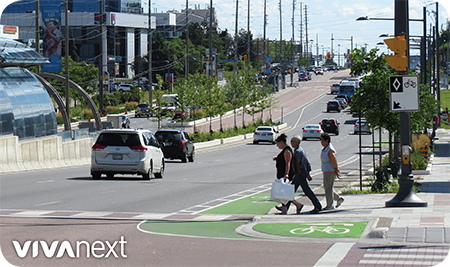
The curb radius describes the shape of a corner, such as when two perpendicular streets come together at an intersection, for example. The curb radius is expressed as a number, taken from the radius of the curve connecting the curbs of the two streets. On a wide suburban corner, the curb radius might be as high as 35, whereas on an urban street corner, it might only be 2.

Most urban settings, including along our vivaNext rapidways, aim for a smaller curb radius wherever possible.  That’s because the smaller the curb radius, the shorter the distance a pedestrian has to walk to get to the other side of the road. A smaller curb radius has other impacts too. It results in more space at the corner, including more space for accessible ramps. It makes it easier to line up crosswalks with connecting sidewalks.  It improves the sightlines for pedestrians and makes pedestrians more visible to drivers. And it slows down turning movements for vehicles going around corners, which is safer for pedestrians.

Of course, curb radius design also considers the needs of drivers, including traffic volume, vehicle size, and their desired speed going around corners. It also has to take into account bike lanes, on-street parking, bus stops, emergency vehicles, and other design requirements.  Whether or not the road is part of a truck route may affect the curb radius, because trucks need a larger turning radius to be able to navigate turns while staying within their lane.

Our final curb radius design isn’t up to us alone, of course.  Our designs reflect standards and requirements set by York Region and the municipalities as part of their broader planning for their regional and local road networks. Those requirements in turn reflect the design standards from a variety of authorities including guidelines from the Transportation Association of Canada and the Ontario Ministry of Transportation.

There’s a lot involved in the design of a simple concrete curb than you probably would have guessed. But the final result is for a more welcoming, safe and accessible streetscape for all users.
 

Categories
Facilities and terminals Stations Transit Urban Planning

connecting people to people

connecting people to people

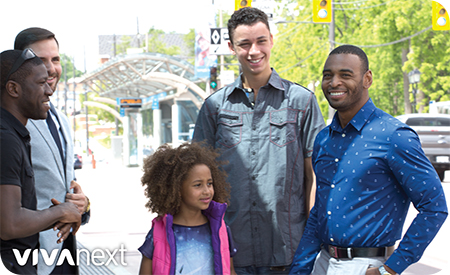
Have you ever wondered why the central markets, main streets and train stations of old cities thrive for so many years? Whether it’s the Temple Street Market in Hong Kong, the piazzas of Italy, or Toronto’s Union Station, it’s important to have a place to gather and connect. Somewhere to meet a friend or someone new, wait for the next bus or train, or just people-watch.

We all want to be around people, at least some of the time – Aristotle once said “man is by nature a social animal.” So in York Region, we’re hard at work building attractive places to spend our “connecting” time. A warm area at the station while you wait for Viva [it won’t be long!]… a place to buy coffee at the SmartCentres Place Bus Terminal in Vaughan, tree-lined sidewalks in Newmarket for walking along Davis Drive, or a trellis-covered plaza with benches to meet a friend at Cornell Terminal in Markham.

In this world of internet and mobile devices it’s easy to find ourselves isolated from the general population, so we’re using smart design to make sure everything we build connects people – not just vehicles.


Categories
Accessibility Construction Stations Subways Technical

matching the heights

matching the heights

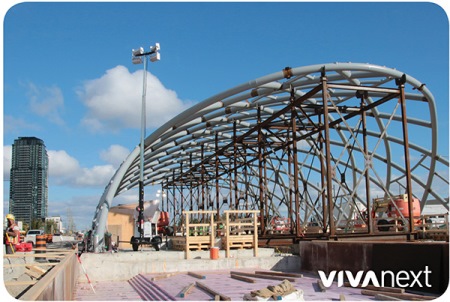
With the extraordinary maneuvering required to install the roof sections of the VMC BRT station in its location in the centre of Highway 7, you might think the most challenging part of this project has been its incredible glass and steel canopy.

It’s true that installing the canopy of the station required a lot of planning and meticulous engineering. But actually, the coordination of the underground subway station with the BRT station above has been – and still is – a much more complex logistical challenge.

the mechanics of it all

Building the actual physical connections between the two structures was involved but not unduly complicated, similar to any building that has a framed structure on top of a concrete slab. Because the top of the station is wider than the lower part and overhangs at the edges, we couldn’t use rebar dowels, which are the most common construction method. Instead, we used mechanical couplings that enabled us to essentially bolt the top to the bottom.

working together

What makes the project more challenging is that the subway station is being built by the TTC, while the above ground BRT station is being built by vivaNext. With two different owners, and two different contractors, the project demands an intensive degree of coordination and planning.

Joint planning work began long ago, starting with establishing the specific requirements for how the project needed to be built, both below and above ground, and inside and outside the subway station. With the TTC building the subway station up to the surface, and vivaNext building the BRT station from the ground up, the heights of floors and ceilings had to line up perfectly.

top to bottom, inside and out

The vertical elements between the lower and upper floors – including the stairs, escalators and elevators – had to be installed early, with no margin for error. Escalators are very rigid, designed to fit perfectly between floors. And because the rapidway runs right through the station, the top of the escalator, stairs and elevator also had to align precisely with the existing level of Highway 7 outside.

At the same time as the TTC was building the lower levels of the subway station, we were outside building the civil works – the roadway, curbs and gutters – that surround the BRT station. Again, because the rapidway runs through the station, the heights of the underground parts of these elements had to fit with the height of the subway box below.

The BRT station is well on its way and is already a head-turner. In the not-too-distant future, all of this engineering and coordination will make it possible for you to step off the escalator at VMC subway station and easily make your way to the BRT station on Highway 7 and beyond.

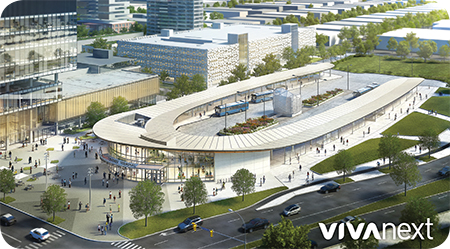
See an artist’s rendering of the VMC BRT station once complete.


Categories
Video

2016 >> all together now!

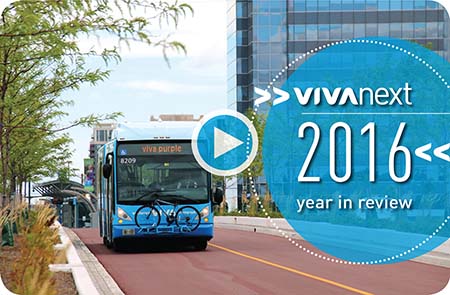
YouTube video: 2016 year in review

Some of the best songs start with just a few notes – maybe the base in a band or the baritones in a choir. Then more and more parts are added, and by the middle of the song everyone is singing or playing different parts, all in harmony. For York Region’s rapid transit system, 2016 was the “middle of the song.”

The prototype station opened in 2011 in Markham, followed by a 10-kilometre rapidway opening in 2013 and 2014 on Highway 7 East. In Richmond Hill, a LEED Silver-certified transit service facility opened in 2015. The Davis Drive rapidway in Newmarket opened for service in 2015, with some final work completed last summer.

Along with finishing Davis Drive, 2016 projects included important utility and prep work along Yonge Street in Newmarket and in Richmond Hill – temporary traffic signals, median work and retaining walls, new hydro poles, water main and gas main replacements. Similar work is being done for the rapidway on Bathurst and Centre Streets in Vaughan, and along Highway 7 west of Highway 400 to Helen Street/Wigwoss Drive.

Highway 7 in Vaughan was a symphony of activity in 2016, with construction wrapping up east of Jane Street to Bowes Road, and work moving ahead quickly on the large rapidway station west of Jane Street that will connect directly to the Toronto-York Spadina Subway Extension.

Bus terminals are planned in Vaughan and in Markham, and in 2016 those projects worked through the “backstage” steps of design and procurement.

A high note in 2016 was the announcement from the Province of Ontario of $55 million in funding to advance the design and engineering for the Yonge Subway Extension [YSE]. The YSE is York Region’s top transit priority, and we’re committed to working with Metrolinx, TTC and the City of Toronto to move this project forward.

In our plans, 2016 was the year we knew most of our projects would be happening, all at the same time, and it was busy! 2017 will be full of accomplishments too, and there are even more rapid transit projects planned for the future. So we plan to keep working on every detail or “note” to make sure our song – a connected transit system – makes it to the finale!


Categories
Construction Rapidways Stations Technical

making sparks fly

making sparks fly

If you’ve been near the future Vaughan Metropolitan Centre [VMC] vivastation recently, you’ve likely seen our welding crews up on man-lifts. And if you’re like most people, you probably didn’t give the welding process much thought – welding is welding, right? Lots of protective clothing, impressive clouds of sparks, and something gets permanently stuck to something else.

Of course, as always with all our engineering and construction activities, there’s so much more going on than meets the eye, and welding on the VMC station is no exception. Here’s the primer on what they’re doing up there, and what some of the complexities are.

Since we’re talking vivaNext, form and function both matter. There are two ways to join two pieces of metal: bolting them together, or welding them. Bolting works well enough, and is the most common method used on bridges, high rises and many other structures. But bolts show, and when the design – as for the VMC station – is for a smooth, seamless architectural look, bolts would be out of place. So welding was chosen as the method to join the pieces of steel throughout the structure.

Welding design takes into account the ultimate strength and performance needed from the structure being joined together, including the loads it will bear, and any flexibility it will require. In the case of the station’s steel superstructure, we are using “full penetration” welding. That means that the two elements being welded together are literally being fused into one piece. Rather than one piece being stuck onto the other, enough heat is applied that the two pieces melt and become one at a molecular level. With this type of welding, it’s not just one surface being glued to another; the joint literally goes through the full depth of the elements being connected. The resulting element is as strong structurally as one solid piece of material.

Once the weld is done, it is reviewed by the welding contractor for certification that the weld meets the required standards including having no impurities or voids. The reviews are generally done visually, although in some cases x-rays will be used. Our general contractor will also do their own quality control, and carry out random spot-checks on many of the welds.

In general, welding can be done until the temperature drops to -18 Celsius. But this specialized kind of welding requires warmer outside temperatures. When temperatures are -5 or below, some weld areas may need to be pre-heated with electrodes.

We’re moving as fast as we can to get the roughly 200 structural welds done, with welders working in shifts, each safely attached by full harnesses to a man-lift while they’re up high. Once the sparks are finished, and because it’s too cold out to paint steel, our last step will be to protect the welded areas with an anti-rust finish.

If you’re in the VMC area, we hope you’ll slow down and look around you. If you do, you’ll be able to admire up close its sleek, architectural lines, and understand all the work that went into making the steel superstructure smooth, strong and beautiful.


Categories
Announcements Facilities and terminals Stations Subways Transit Urban Planning

a connected transit terminal

a connected transit terminal

This morning, we marked the beginning of construction for a new YRT bus terminal in Vaughan Metropolitan Centre [VMC]. The news release gives the basic project information, but doesn’t delve into how this terminal will connect in the GTA transit network:

bus

Well, it is a bus terminal. YRT buses will use this terminal, taking customers in and out of York Region’s neighbourhoods and to places farther away like Brampton and northern Toronto. Customers will also be able to walk to the VMC vivastation in the middle of Highway 7, where Viva will take them away on dedicated bus rapid transit lanes. They’ll walk about two minutes above ground, or when the weather is frightful they’ll take the underground path and escalator, elevator and stairs to reach the vivastation.

subway

Customers will take the underground path or walk along landscaped paths outside to the VMC Subway Station entrance just south of the terminal, to access the underground concourse for the Toronto-York Spadina Subway Extension. The subway concourse is actually under the vivastation on Highway 7 – stay tuned for a future blog about this.

walking and cycling

The VMC area is planned as a walkable area with tree-lined sidewalks and places to live, work, shop and take transit. The terminal will meet accessibility standards, and customers will be able to walk or cycle there from any direction.

driving

The terminal is near the intersection of Highway 400 ad Highway 407, so a passenger pick-up and drop off [aka. “kiss ‘n ride”] will be included, encouraging carpooling.


So it’s not your typical bus terminal and it’s more than a place to wait for the bus. It’s about connections, and where they’ll take you from here.


Categories
Construction Rapidways Safety Traffic signals

changing lights

Most people look at traffic signals every day, but don’t notice how they’re configured, or why they’re installed the way they are. Traffic signals change quite a bit with our construction projects, and not just from green to yellow to red.

Once a project is underway, each intersection in the construction area receives a new, temporary traffic signal pole on each corner, set farther back from the road. Then temporary traffic signals are strung on wires across the intersection from these temporary poles.

Once the temporary poles are in place, the old poles and signals are removed, including any poles in the centre median in each direction.

Having the temporary poles farther back from the road allows access for relocating utilities and widening the road. As lanes are shifted and the road is widened, the temporary signals are adjusted along the wires to ensure they’re in the correct place for traffic and pedestrians.

Later in the project, new poles are installed in their final location, and permanent traffic signals are added, along with a dedicated left/U-turn signal.

Each time the traffic signals are changed, paid-duty police officers are on hand at each intersection for a few hours to ensure traffic flows safely through the intersection. If you’re on Yonge Street in Newmarket or Bathurst and Centre Streets in Vaughan, you’ve seen this firsthand recently.

For a peek at the final outcome, check out the sections of rapidway on Highway 7 East in Markham and Davis Drive in Newmarket.

Despite the cold weather, the vivaNext team continues to work out on the corridors and behind the scenes – making progress as seamlessly as possible.


Categories
Construction General Rapidways Utilities Video

a year on Yonge

a year on Yonge

‘Tis the season when we sit back and reflect on the year which has passed and prepare for the year ahead.

2016 was a big year for utility work on Yonge Street in both Newmarket and Richmond Hill. Gas and telecommunications installations were completed in Newmarket and water main and gas work made significant progress in Richmond Hill.

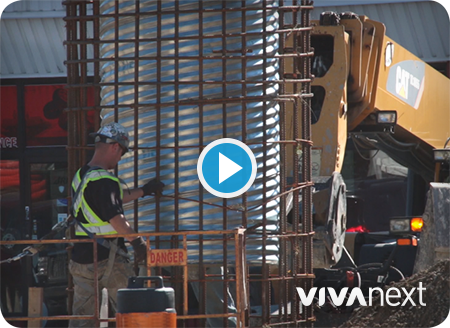
Through all of the construction barrels, mud, noise and mess on Yonge Street, we took pictures every step of the way and put together a video which captures the progress of rapidway construction in both Newmarket and Richmond Hill.

It is amazing to look back and remember all that can be achieved in just one short year. We look forward to another productive year in 2017!

Categories
Community Events Video

next stop… Yonge! the sky is the limit!

YouTube video: next stop... Yonge! Colouring Contest

What do you get when you give imaginative minds a box of pencil crayons, paper and creative license to draw their vision of the future of transit? Some pretty amazing masterpieces!

This fall we teamed up with the Town of Newmarket’s Recreation and Culture Department along with the Newmarket Public Library to give kids between the ages of 6-12 a challenge. We wanted to see their vision of what transit on Yonge Street will look like in the future. We received many colourful masterpieces brought to life as part of our Next Stop….Yonge! Colouring Contest.

Check out our latest video for a glimpse of the amazing entries we received. We’re sure you’ll agree that selecting our winners was no easy task. Congratulations to Avery [age 6-8], Sienna [age 9 and 10] and Olga [age 11 and 12]! Visit the contest page to see all the artwork we received.

We can’t wait to see what the future of transit holds for the next generation, the sky is the limit based on their imagination!

To find out what we’ve been up to in your community, check out our community events page.


Categories
Urban Planning

building sustainable communities

YouTube video: Building Sustainable Communities

As our towns and cities grow, we need to prepare for the future. Long term planning means that everything we need is all in the right place ahead of time. That means all the major necessities: transportation, utilities, community services and more.

In York Region, we know our population is continuing to grow – by 64% by 2031. Employment is also expected to increase by a whopping 59%, and all this will mean more demands on our roads in general [50% more demand in the morning peak], and especially an increased need for fast, convenient transit.

That’s why rapid transit systems are part of the plans in York Region. Bus Rapid Transit systems are supplying current and future demand with Viva rapidways that offer time savings. On the Highway 7 rapidway in Richmond Hill and Markham, travel times are 42% faster than in mixed traffic.

These improvements to our infrastructure are appreciated. On Davis Drive in Newmarket – the newest rapidway to open – YRT/Viva ridership increased by 39% between February 2016 and February 2015. According to a 2015 survey, 80% of residents living near an opened rapidway believe the project added value to their community.

From Markham to Newmarket to Richmond Hill and Vaughan, it’s about maintaining vibrant, welcoming communities that are prepared for growth and sustainable for many years to come.